

Most tenants in Singapore are shocked by reinstatement costs only when the landlord issues the handover notice.
It’s a scenario I see play out constantly: A business owner is excited to move to a new, bigger office or shop. They focus entirely on the renovation of the new place, completely forgetting the lease obligation they signed three years ago for their current space. Then, two months before the lease ends, reality hits. The landlord expects the unit back in its original “bare” condition, and the quote to make that happen is thousands of dollars more than expected.
If you are leasing commercial property in Singapore, whether it’s an office in the CBD, a retail shop in a mall, or a warehouse in Tuas ,understanding reinstatement works is not optional. It is a critical part of your exit strategy. Below, we break down the BCA requirements, cost estimates, and the exact checklist you need to get your deposit back.
Understanding Reinstatement Works in Singapore
In simple terms, reinstatement works refer to the construction and demolition process required to return a rented property to its original state before you hand it back to the landlord. Think of it as a factory reset for the building. If you walked into a bare concrete shell three years ago, the landlord expects to see that same bare concrete shell when you leave. No partitions, no carpets, no trace you were ever there.
It’s Not Just “Renovation” or “Repair”
It is important to distinguish reinstatement from other types of work:
- Renovation: Adding value or aesthetics to a space.
- Repair: Fixing broken items (like a leaky tap).
- Reinstatement: Removing additions to return to the original base condition.
In the industry, you might hear contractors refer to this as “make good works” or “lease restoration works.” Regardless of the terminology, the goal is the same: satisfy the landlord’s handover requirements so you can leave without penalty.
Why Reinstatement Works Matter (Key Factors Tenants Must Know)
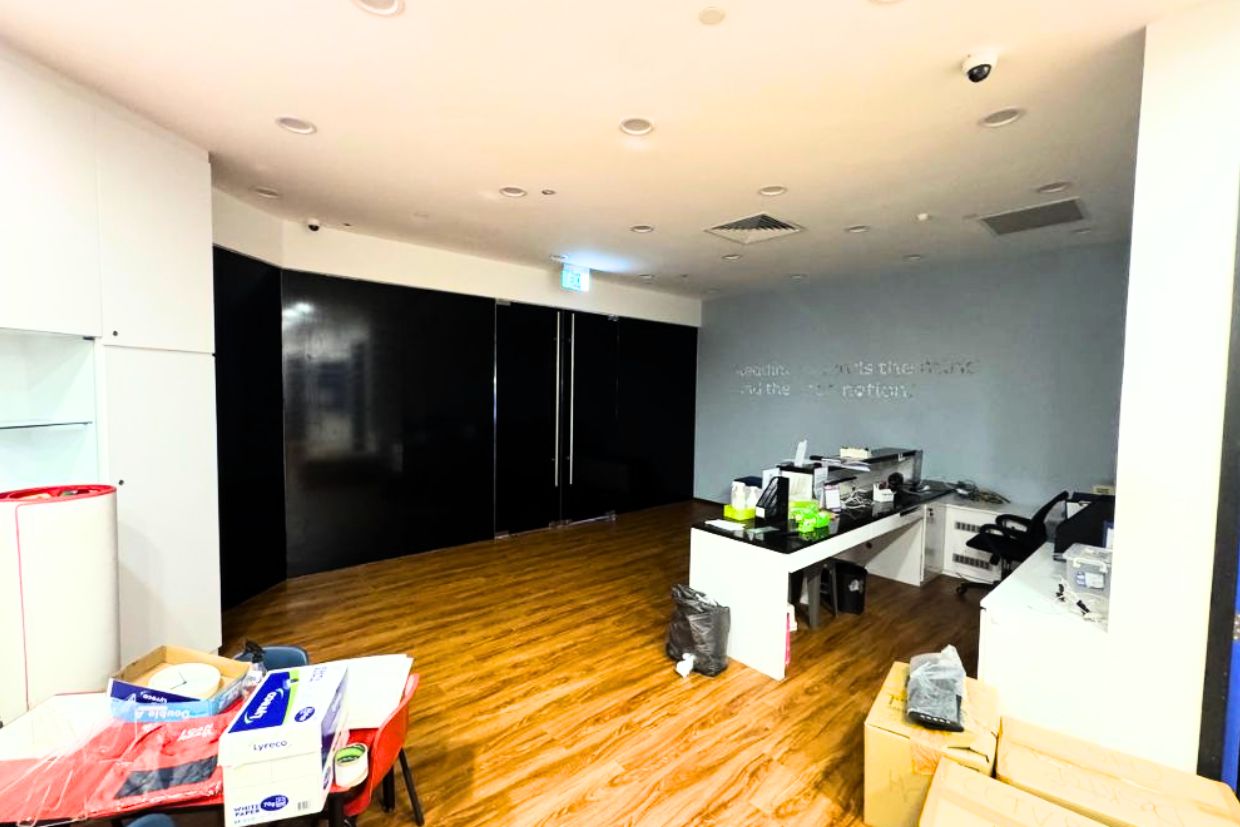
Many tenants assume they can just sweep the floor, lock the door, and leave. This is a dangerous misconception that can lead to legal disputes and massive financial losses.
Lease Obligations Under Singapore Tenancy Agreements
Almost every commercial Tenancy Agreement in Singapore includes a reinstatement clause. It typically states that the premise must be returned in its “original bare condition” or “as-is” condition based on the handover date.
Real-world example:
I once worked with a tenant who left their glass partitions up, thinking the next tenant would want them. The landlord rejected the handover. The tenant was forced to pay for the removal plus a penalty for the delay. Unless the incoming tenant agrees in writing to take over your fittings (which is rare), you must remove everything.
Hidden Risks & Common Charges Tenants Face
If reinstatement isn’t done correctly, you face risks beyond just the construction costs:
- Double Rent Penalties: If you miss the expiry date by even one day, landlords will charge double rent. This is the ‘holding over’ penalty, and it accumulates daily.
- Damages: If your contractor accidentally damages the building’s sprinkler system or public corridor during debris removal, you are liable.
- M&E Issues: Cutting wires instead of properly terminating them can trip the building’s power, leading to fines from the building management.
Compliance & Safety Requirements
Reinstatement isn’t the Wild West. In Singapore, works must comply with:
- BCA (Building and Construction Authority): For structural safety.
- SCDF (Singapore Civil Defence Force): For fire safety (sprinklers/smoke detectors).
- Building Management: Every commercial building has its own set of fit-out and reinstatement guidelines.
The Types of Reinstatement Works (Complete Breakdown)
Reinstatement varies significantly depending on whether you are in a shophouse, a Grade A office, or an industrial unit. However, the core scope generally falls into four categories.
1. Demolition & Dismantling Works
This is the “heavy lifting” phase. It involves removing everything you installed.
- Partition Removal: Gypsum boards, glass walls, and meeting rooms.
- Flooring: Hacking away floor tiles, peeling up carpet glue, or dismantling raised floor systems (common in server rooms).
- Built-in Furniture: Pantries, reception desks, and cabinets.
2. M&E Reinstatement (Mechanical & Electrical)
This is often the most technical part. You cannot simply rip cables out of the ceiling.
- Electrical: Removing added power points and data cables, but retaining the original distribution board (DB) configuration.
- Air-conditioning: Removing added diffusers or ducting and chemically cleaning the main units.
- Fire Protection: Relocating sprinkler heads back to their original grid positions (requires a licensed professional).
3. Carpentry, Painting & Surface Restoration
Once the demolition is done, the unit will look rough. You must make it look new again.
- Patching: Filling holes in walls and floors caused by drilling.
- Painting: Painting all walls white (or the building’s standard color).
- Ceiling: Replacing damaged false ceiling boards or ceiling grid bars.
4. Cleaning & Final Touches
- Disposal: You cannot use the building’s bins. All debris must be hauled to NEA-approved disposal facilities (like the ones in Sarimbun or Tuas Marine Transfer Station), and haulage fees are charged by the truckload.
- Deep Cleaning: A chemical wash and polish to ensure the unit is dusty-free for the final inspection.
How to Calculate Reinstatement Costs (Beginner-Friendly Framework)

Budgeting for reinstatement is difficult because no two units are the same. However, you can estimate costs based on a few key influencers.
Factors that Influence Pricing
- Size of Unit: Larger units have economies of scale, but higher total costs.
- Ceiling Height: High ceilings (especially in industrial lofts or shophouses) require scaffolding, which increases labor costs.
- Complexity: Did you hack the floor tiles? Did you install a wet pantry with plumbing? These add to the cost.
- Building Restrictions: Premium office buildings in CBD often restrict work hours to nights/weekends, which triggers overtime pay for workers.
Price Benchmarks in Singapore (Estimated)
- Small Office / Shop (under 1,000 sqft): $3,000 – $7,000
- Medium Office (1,000 – 3,000 sqft): $8,000 – $20,000
- Large Office / Industrial (3,000+ sqft): $20,000 – $50,000+
Note: These are estimates. Always get a specific quote based on your site conditions.
If you are nearing the end of your lease, do not wait. Get a Reinstatement Cost Quote at least 2–3 months before your move-out date to avoid last-minute price surges.
Step-by-Step Guide to the Reinstatement Process
Managing a reinstatement project requires a timeline. Here is the workflow you should follow.
Step 1 – Site Assessment & Quotation (3 Months Before Expiry)
Invite contractors to survey your site. They need to see the current condition and compare it against the original floor plan. They will check the M&E conditions and identify potential challenges (e.g., restricted lift access).
Step 2 – Landlord Approvals & Permit Submissions (1–2 Months Before Expiry)
Before a single hammer is swung, your contractor must submit a refundable deposit to the building management. They also need to apply for permits for:
- Hacking/Demolition.
- Hot works (if cutting metal).
- General renovation.
Step 3 – Execution of Works (2–3 Weeks Before Expiry)
The physical work begins.
- Protection: Lifts and corridors are protected with padding.
- Demolition: Removal of loose items and built-ins.
- M&E Work: Electrical and AC termination.
- Make Good: Patching and painting.
- Clean: Removal of waste.
Step 4 – Final Handover Inspection
Your landlord will walk through the unit with a checklist. If everything passes, you hand over the keys. If not, you may need to do touch-ups. To ensure you don’t miss anything, refer to our detailed Reinstatement Checklists.
Choosing the Right Reinstatement Contractor

Not all contractors are created equal. A general handyman might be cheaper, but they may lack the insurance or licenses required by commercial buildings.
Checklist: What to Look For
- BCA Registered: This ensures they are a legitimate construction entity.
- Public Liability Insurance: Mandatory for working in commercial buildings (usually minimum $1M coverage).
- M&E Capability: Do they have their own electricians, or do they outsource? Outsourcing can cause delays.
- Experience with Your Building: If a contractor knows your building manager, the permit process is often faster.
Comparison: Freelancer vs. Specialist
| Feature | Freelance Contractor | Full-Service Reinstatement Specialist |
| Cost | Low | Medium/High |
| Paperwork | You handle it | They handle it |
| Speed | Varies | Fast & Scheduled |
| Risk | High (Safety/Delay) | Low (Guaranteed Handover) |
Reinstatement for Offices vs Retail vs F&B vs Warehouses
The industry you are in dictates the complexity of the work.
Office Reinstatement
This is usually the most straightforward, but the devil is in the details. The biggest hidden cost in office reinstatement is often the under-floor trunking and data cabling. If you installed server racks with extensive cabling, every meter of that wire must be pulled out.
Retail Reinstatement
Retail shops often have heavy branding elements. You will likely need to remove:
- Security gantries at the entrance.
- Heavy feature walls or mirrors.
- Signage (and patching the holes left in the facade).
- Floor tiles (hacking tiles is noisy and dusty, requiring specific work hours).
F&B Reinstatement
F&B is the most complex and expensive.
- Kitchen Exhaust: Ducting must be dismantled and capped.
- Gas Pipes: Must be terminated by a Licensed Gas Worker.
- Grease Trap: Must be pumped clean and removed or restored.
- Waterproofing: If you hacked the kitchen floor, waterproofing must be checked.
Warehouse Reinstatement
While industrial units look simple, they are huge.
- Racking: Bolted-down racking leaves deep holes in the floor that need epoxy filling.
- Electrical Load: If you upgraded the power supply for machinery, you might need to downgrade it back to the original provision.
Common Mistakes Tenants Should Avoid
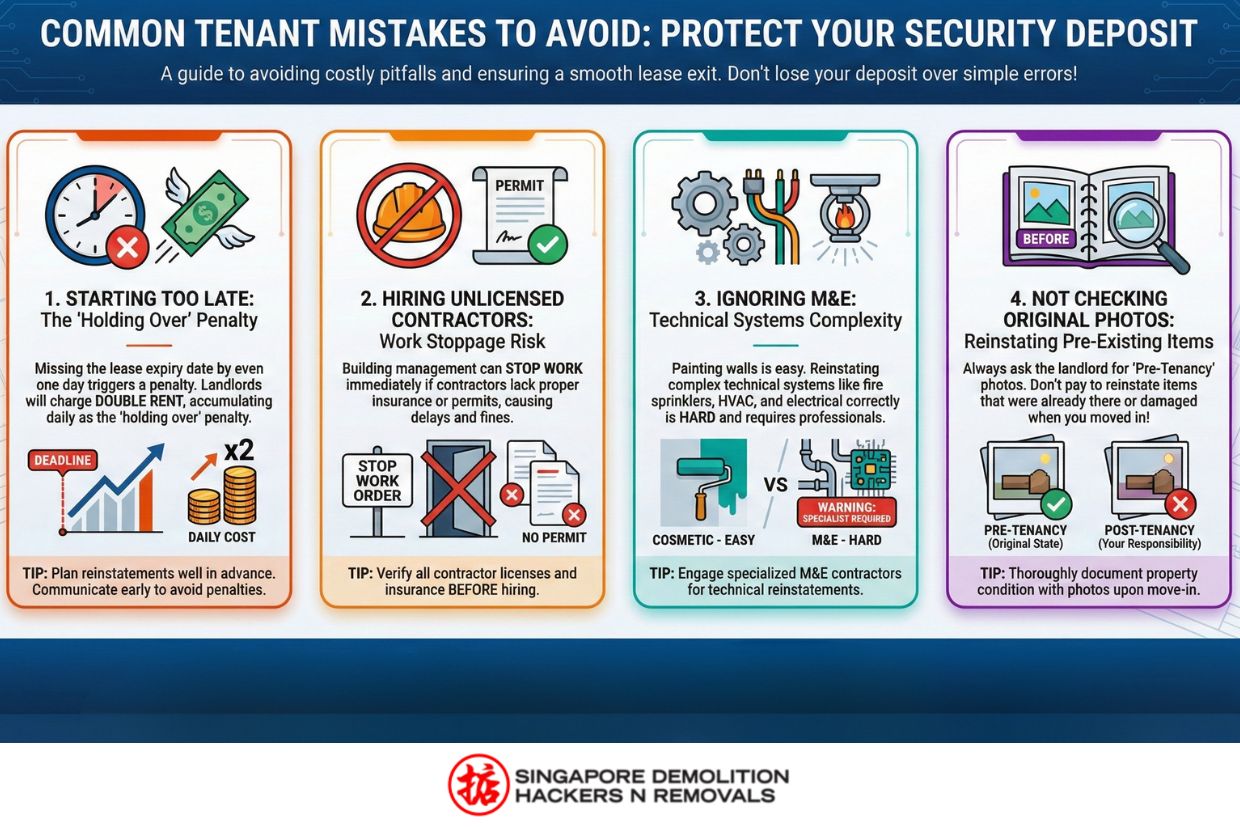
I have seen tenants lose their entire security deposit over simple mistakes. Avoid these pitfalls:
- Starting Too Late: If you miss the expiry date by even one day, landlords will charge double rent. This is the ‘holding over’ penalty, and it accumulates daily.
- Hiring Unlicensed Contractors: Building management can stop work immediately if your contractor doesn’t have the right insurance or permits.
- Ignoring M&E: Painting the walls is easy. Reinstating the fire sprinkler system correctly is hard. Don’t overlook the technical systems.
- Not Checking Original Photos: Always ask the landlord for the “Pre-Tenancy” photos. Don’t reinstate something that was already there when you moved in!
To help you navigate your reinstatement journey, check out these resources:
- Looking for professional help? Visit our reinstatement services page.
Conclusion
Reinstatement works are an unavoidable part of renting commercial space in Singapore. While they can be costly and stressful, they don’t have to be a disaster. By understanding the scope, starting early, and hiring the right professionals, you can ensure a smooth handover. Remember, the goal is to get your security deposit back and move on to your new business chapter without legal baggage. Don’t leave it to the last minute.
Are you planning a move soon? Contact us today to discuss your reinstatement needs and ensure a penalty-free handover.
FAQs About Reinstatement Works
FAQ 1: What exactly is included in reinstatement works?
It typically includes removing all temporary fixtures (partitions, false ceilings, flooring), terminating electrical/plumbing connections, repairing damages, and painting the walls to return the unit to its original bare condition.
FAQ 2: How early should I start planning reinstatement before handover?
You should start looking for a contractor and getting quotes 3 months before your lease expires. Actual physical work should ideally be completed 1 week before the lease end date to allow time for inspection and touch-ups.
FAQ 3: Why are reinstatement costs so high in Singapore?
Costs are driven by labor shortages, high disposal fees (tipping fees at dumping grounds), and strict compliance requirements from BCA and building management, which often necessitate working during off-peak hours (overtime pay).
FAQ 4: Can I negotiate reinstatement terms with my landlord?
Yes, but this must be done before you sign the tenancy agreement. Sometimes, you can negotiate to hand over the unit “fitted” if the incoming tenant wants your renovation, but the landlord must agree to this in writing.
FAQ 5: How long does reinstatement usually take?
For a standard office (under 2,000 sqft), it takes about 7–10 days. Larger spaces or complex F&B units with heavy hacking/demolition can take 2–3 weeks.
FAQ 6: Is it necessary to hire a BCA-licensed contractor?
For most commercial buildings in Singapore, yes. Building management usually requires contractors to submit their BizSafe Level 3 or BCA registration and public liability insurance before granting a permit to work.
What Are Reinstatement Works? Quick Summary
| Topic | Summary |
|---|---|
| What Reinstatement Means | Returning your office, shop, F&B unit or warehouse to its original bare condition before handover. |
| Why It Matters | Required in almost all Singapore commercial leases. Avoid penalties, rejected handovers, double rent, and loss of deposit. |
| Typical Work Involved | Demolition, removing partitions/flooring/cabling, restoring M&E, patching, painting, and NEA-approved disposal. |
| Cost Range | Small/medium units usually cost between $3,000 and $20,000 depending on size and complexity. |
| Key Risks | Late planning, M&E mistakes, missing permits, not matching original move-in condition. |
| Planning Timeline | Start at least 3 months before lease expiry to avoid delays and penalties. |
| Property Types | Offices, retail shops, F&B units, and warehouses all have different reinstatement requirements. |
| Outcome of Proper Reinstatement | Smooth handover, compliance with building rules, and successful return of deposit. |