

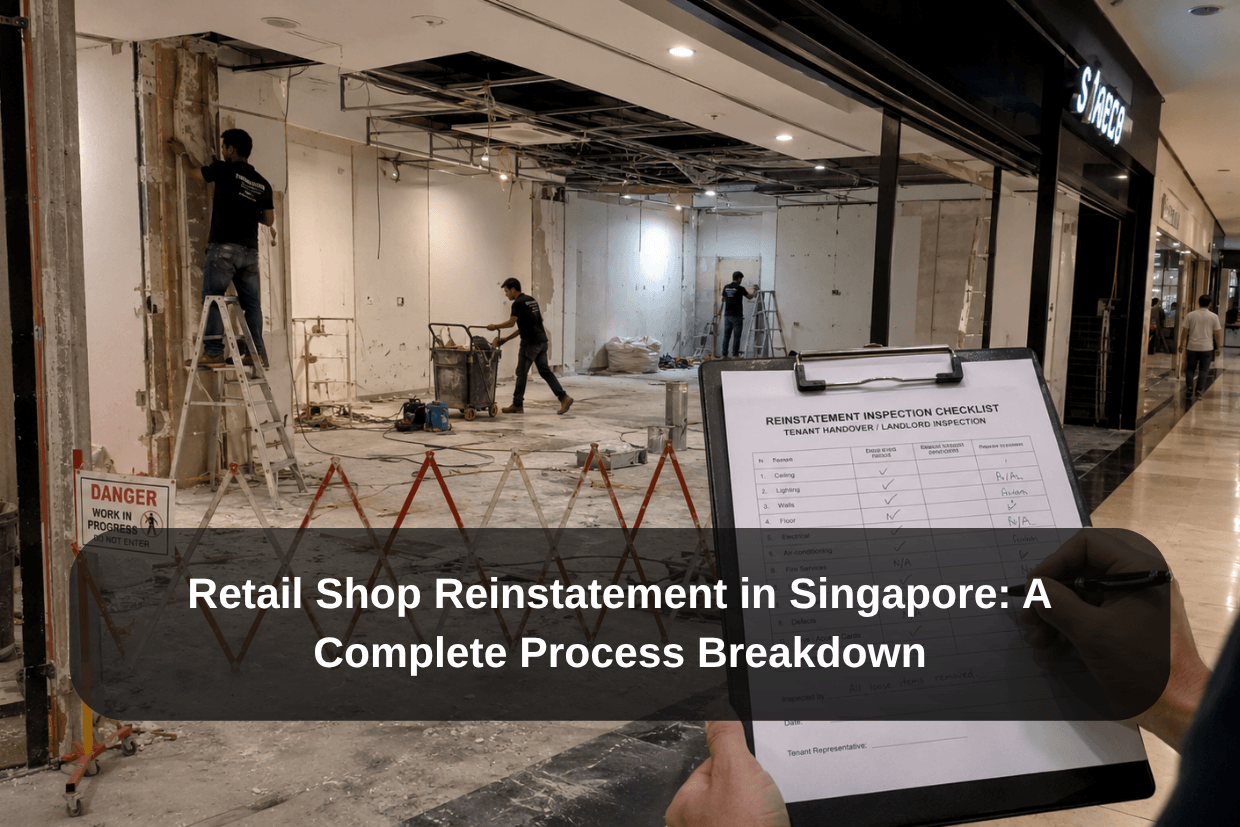
What Is Retail Shop Reinstatement?

The Legal Basis for Reinstatement in a Singapore Retail Lease
Reinstatement obligations are embedded in commercial tenancy agreements from the date of signing. The lease specifies that the tenant must return the premises to the condition in which it was received, which, in practice, means the shell condition documented at the original handover. This obligation cannot be negotiated away at lease expiry.
What “Restoring to Original Condition” Actually Means for a Retail Space
Shell condition in Singapore’s retail context means the bare, unfinished space as it was handed over before any tenant fit-out. For some mall landlords, this means exposed concrete with basic electrical stub-outs. For others, it means painted walls with a suspended ceiling grid but no tiles. The definition is specific to each tenancy and is found in the original handover documentation, not in a general standard.
How Retail Reinstatement Differs from Office or Industrial Reinstatement
Retail fit-outs involve more mechanical, electrical, and ACMV modifications than office fit-outs. Mall management adds a compliance layer that does not exist in standalone office buildings: contractor approval processes, ACMV coordination with the building’s maintenance contractor, and facade protocols requiring formal sign-off.
Who Is Responsible for Reinstatement: Tenant, Landlord, or Contractor?
The tenant is responsible. Not the contractor who performed the fit-out. Not the contractor performing the works. When the landlord’s inspector identifies an incomplete scope, the notice goes to the tenant. Delegating the compliance check entirely to the reinstatement contractor without independent verification transfers the work but not the risk.
The Reinstatement Schedule: Your Most Important Document
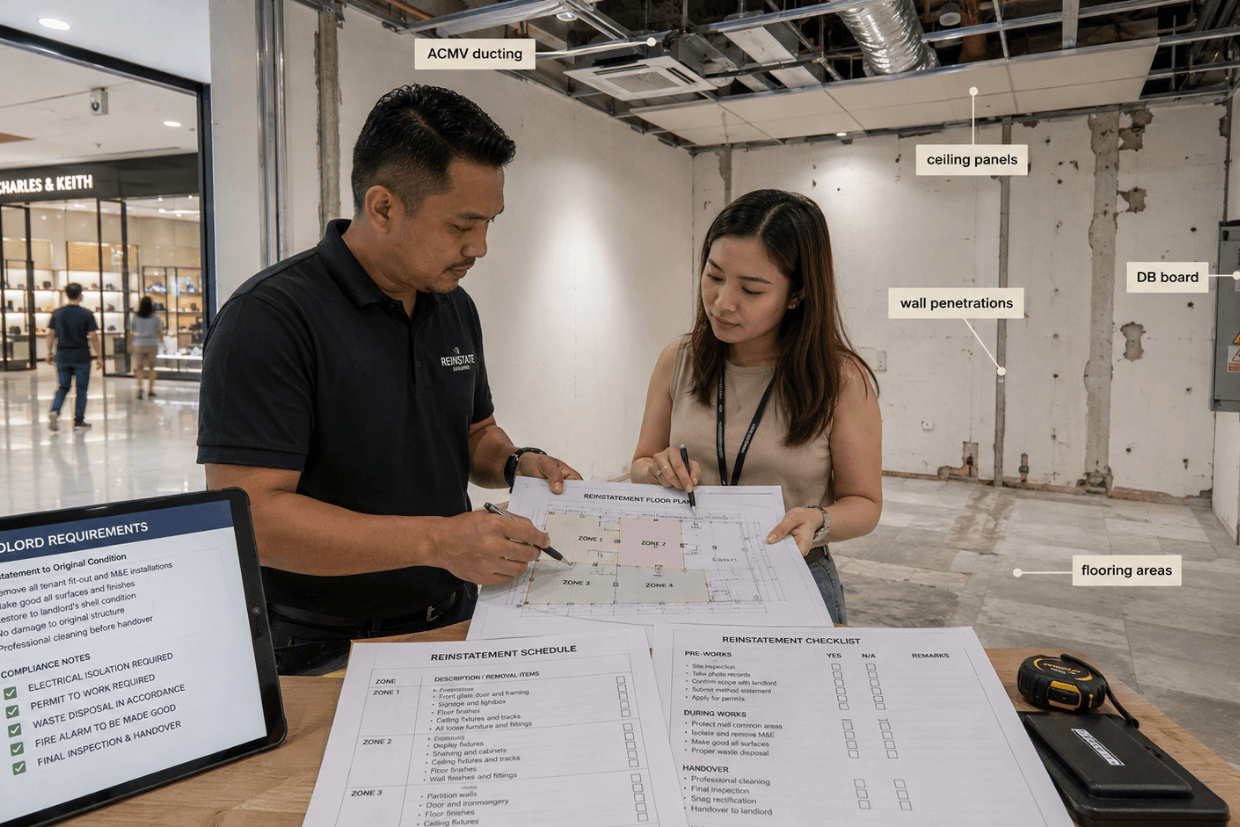
What a Reinstatement Schedule Is and When Landlords Issue It
The reinstatement schedule is the formal document specifying every element that must be removed and every surface that must be restored. It is typically issued three to six months before lease expiry, but can arrive as late as 4 to 6 weeks before. Requesting it before formal issuance is one of the most effective ways to create usable project lead time.
How to Read and Interpret a Mall or Landlord’s Reinstatement Schedule
Map every line item against the current physical condition of the unit, zone by zone. The most commonly misunderstood items are ACMV removal requirements, reinstatement of the original distribution board (DB board), and the distinction between “remove” and “make good.” Remove means full physical extraction. Make good means restoring the affected surface to the defined standard after removal, including patching, levelling, and preparation.
When a schedule item is ambiguous, seek written clarification from the landlord’s representative before any work begins.
What to Do If the Schedule Is Issued Too Close to Your Lease Expiry Date
If the schedule arrives with less than four weeks before expiry, options include requesting a short lease extension at daily rent, negotiating a phased handover, or mobilising multiple contractors simultaneously. Document the late issuance in writing. It may become relevant in a deposit dispute.
The Full Scope of Retail Shop Reinstatement Works
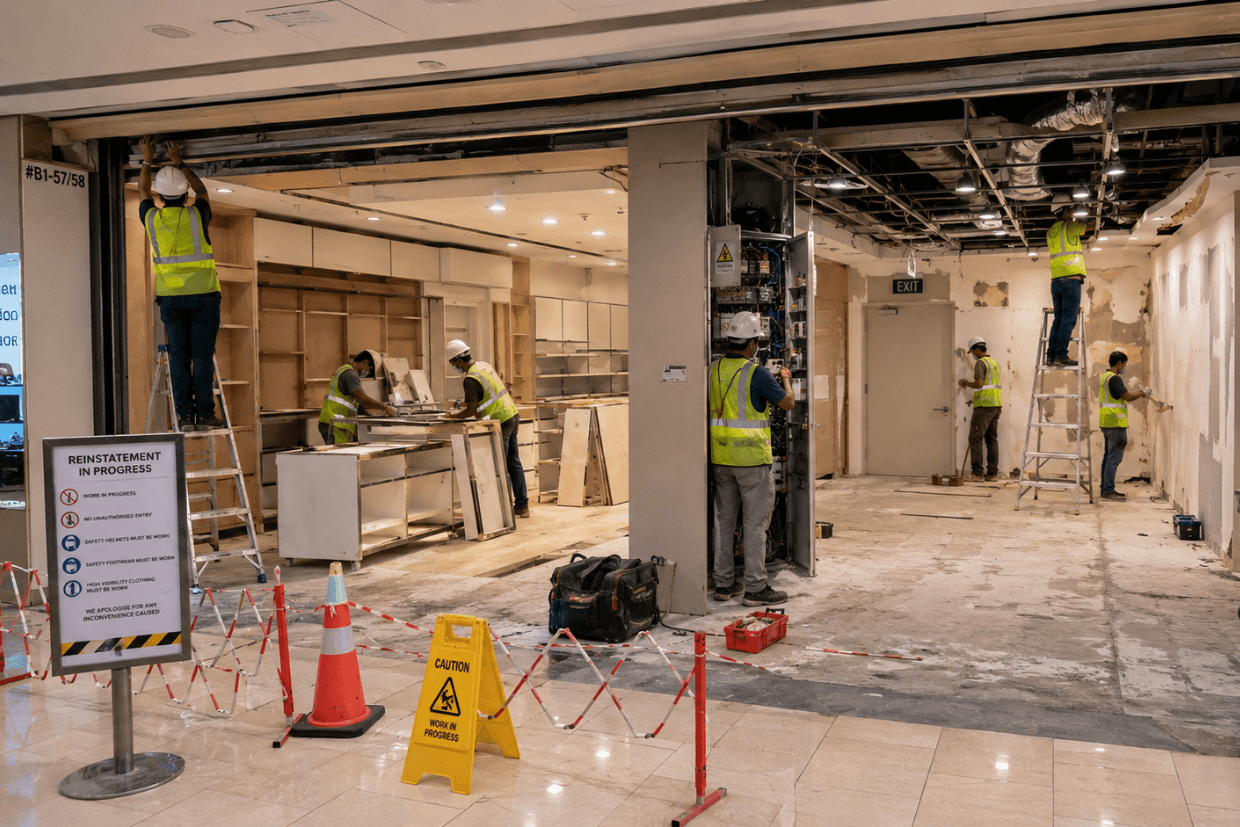
Category 1: Removals – What Must Come Out
Fixtures, Fittings, Display Systems, and Shelving
All tenant-installed shelving, display cases, counters, and point-of-sale structures must be removed in full, including anchor bolts, fixings, and floor or wall penetrations created for installation.
Partitions, Feature Walls, and Ceiling Systems
Non-structural partitions, drywall, glass partitions, feature walls, suspended ceiling systems, bulkheads, and light boxes installed over the original ceiling structure must be fully removed.
Electrical Installations, Lighting, and Data Points
All tenant-installed electrical fittings, tracks, sub-mains, and data points must be removed back to the original stub-out. An EMA-licensed electrical worker must certify the electrical work, and documentation must be submitted to the landlord.
ACMV Additions: Air Conditioning, Mechanical, and Ventilation Works
The scope item most consistently missed is ACMV removal, and it is the costliest gap in the reinstatement scope. It covers all tenant-installed fan-coil units, duct modifications, grille additions, and connections to the base-building system. ACMV removal in a managed mall environment requires coordination with the building’s maintenance contractor and cannot be accelerated once the coordination process begins.
Signage, Branding Elements, and Fascia Boards
Full removal means not just the sign face but the mounting box, structural frame, cabling, and all facade penetrations, made good to the original surface condition.
Specialised Flooring and Floor Coatings
Where the original floor was bare screed, tenant-installed flooring must be removed and the screed reinstated to the original level. Confirm this against the handover documentation before proceeding.
Category 2: Restoration – What Must Be Brought Back
Restoring Walls, Ceilings, and Floors to Shell Condition
Making good means more than patching holes. Walls must be ready to receive a new finish. Ceiling structures must be restored to their original configuration. Floor levels must match the defined handover standard.
Reinstating Original Electrical Supply Points
The DB board and supply points must be returned to the configuration specified in the original handover documentation, not to a general standard.
Patching, Making Good, and Surface Preparation
Making good is a defined scope item. Filler applied over penetrations without proper surface preparation is routinely rejected at handover inspection.
Works That May Require PE Endorsement or Authority Approval
Structural modifications made during the fit-out may require a Professional Engineer endorsement from the Building and Construction Authority before removal. Works affecting fire safety systems may require SCDF coordination. Identify these requirements during the schedule review stage, not during work execution.
Timeline and Costs: What to Realistically Plan For
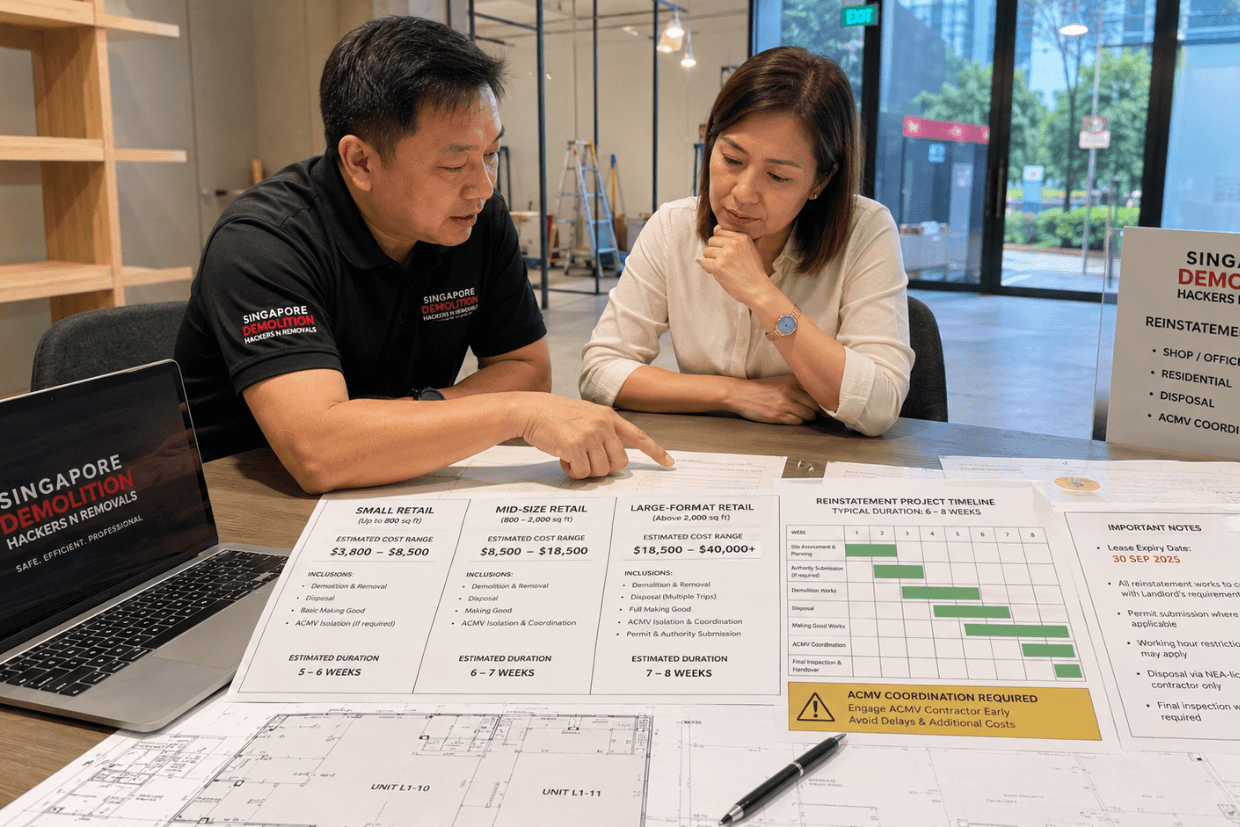
How Far in Advance Should You Start the Reinstatement Process?
Six to eight weeks minimum before lease expiry for a standard retail unit. Contractor engagement alone requires two to four weeks of lead time before work can commence.
How Long Does Retail Shop Reinstatement Typically Take?
Duration depends on unit size, fit-out complexity, and ACMV coordination. The table below provides indicative estimates.
Unit Size | Typical Duration | Approximate Cost Range | Key Variable |
Small retail (under 200 sqft) | 1 to 2 weeks | $8,000 to $20,000 | Fit-out complexity |
Mid-size retail (200 to 500 sqft) | 2 to 3 weeks | $20,000 to $50,000 | ACMV scope |
Large-format retail (500 sqft and above) | 3 to 6 weeks | $50,000 and above | Structural modifications |
Note: Figures are approximate, indicative ranges. Actual costs vary based on fit-out complexity, ACMV scope, and specific mall management requirements.
What Causes Reinstatement Projects to Run Over Time or Budget?
Late schedule issuance, ACMV coordination delays, and missed scope items discovered mid-works are the three consistent causes. All three are addressable through early schedule review, pre-work ACMV verification, and a full-scope map before work begins.
Common Retail Reinstatement Mistakes and How to Avoid Them
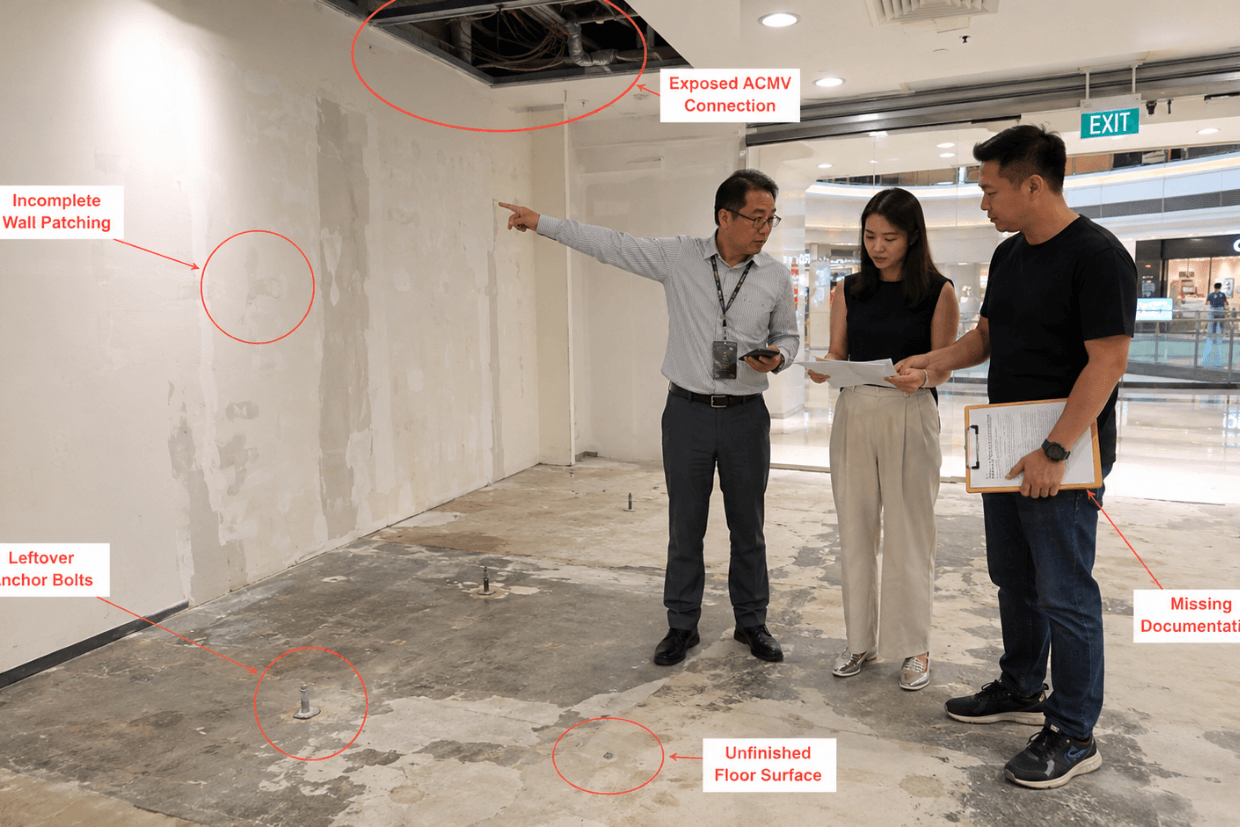
Underestimating the Scope of the Reinstatement Schedule
Count schedule line items, not visible fittings. Many items are not visible during a walkthrough: sub-ceiling ACMV connections, sub-floor drainage modifications, and electrical changes made inside walls.
Missing ACMV and Mechanical Services Removal Requirements
Confirm all ACMV items in the schedule with the building’s maintenance contractor before work begins. They will identify what was added and what the base building restoration requires.
Starting Too Late and Running Into Lease Expiry
Six to eight weeks minimum before expiry is the safe threshold. A compressed works programme leads to a failed inspection, which leads to an extended tenancy at penalty rate.
Failing the Final Handover Inspection and Its Cost Consequences
Self-audit every schedule item before calling for inspection. Items not resolved within the snagging deadline are completed by the landlord’s contractor at the tenant’s cost.
Assuming Certain Elements Are Excluded Without Confirmation
The standard is the original handover condition for this specific tenancy. Get written confirmation from the landlord before leaving any element in place.