

Why Understanding PE Endorsement Fees Matters for Your Singapore Project
What Are PE Endorsements?
A PE endorsement is a legal certification in Singapore ensuring that engineering work complies with safety and regulatory standards. It is a mandatory “sign-off” by a licensed Professional Engineer (PE) required for construction, electrical, and mechanical projects.
These endorsements validate that engineering work meets Singapore’s regulatory and safety standards across multiple sectors. Construction projects, industrial facilities, mechanical systems, and regulated technical infrastructure all require PE endorsement before proceeding.
The endorsement serves as official verification that a qualified, PEB-registered (Professional Engineers Board) professional has reviewed and approved specific technical work and assumes legal responsibility for it.
Common Misconceptions About Costs
Many applicants believe PE endorsement fees are straightforward: a simple, fixed cost from a professional engineer or regulatory body.
This is a myth.
In reality, underestimating these fees leads to major budget overruns and project delays. The biggest misconception? That the endorsement fee is “just a small cost.”
The actual cost often doubles or triples once you factor in:
- Documentation preparation
- Compliance checks and revisions
- Administrative processing fees
- Unexpected resubmission charges
A business might budget $1,500 for a “PE endorsement fee,” only to discover they actually need $3,500–$5,000 when hidden expenses emerge mid-project.
Real-World Pain Points
The Jurong Industrial Warehouse Case: A medium-sized manufacturing company undertook a structural and mechanical project requiring PE endorsement. They allocated $2,000 based on an initial quote.
However, they didn’t account for:
- Document preparation and technical drawing revisions ($800)
- Compliance consultation with a third-party auditor ($600)
- Processing delays requiring resubmission ($500 in additional fees)
- 18-day project halt while awaiting approval
Actual cost: $3,900
This scenario is not uncommon. Small businesses especially suffer financial strain when PE endorsement budgeting is incomplete. Individual project managers face similar surprises when navigating regulatory approval processes alone.
Breaking Down PE Endorsement Fees and Processes
How PE Endorsement Fees Are Structured
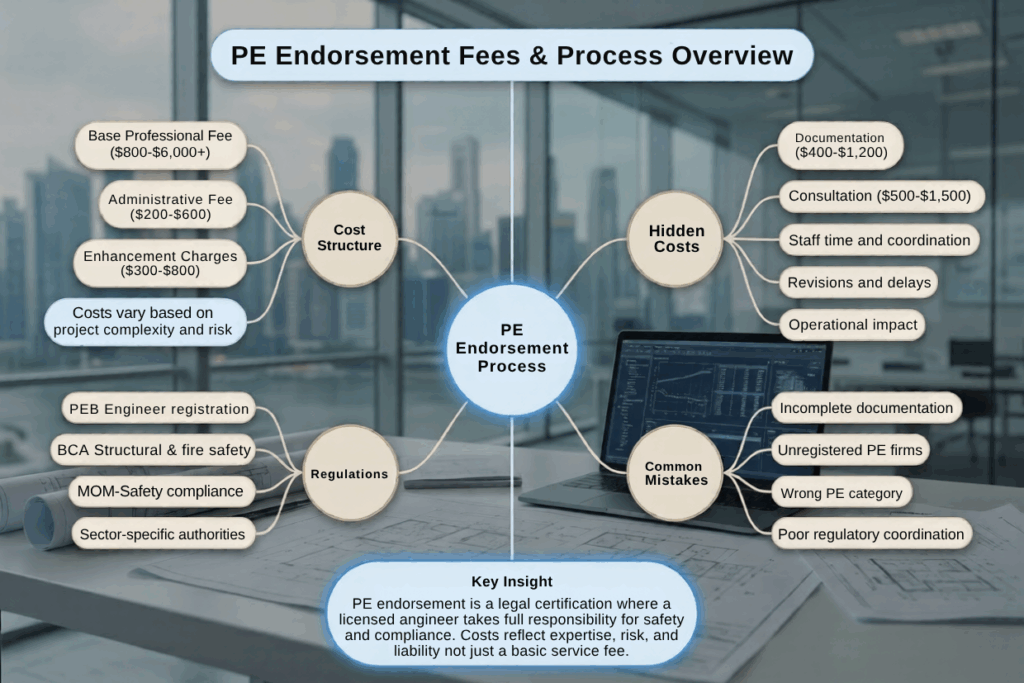
PE endorsement fees typically include four main components:
Base Professional Fee The PE’s charge for reviewing, assessing, and endorsing your work. Varies by project complexity:
- Simple systems: $800–$1,500
- Complex structures: $2,000–$4,000
- Specialized industrial work: $3,500–$6,000+
Administrative Processing Fee Charged by the regulatory body or PE firm for formal application processing, file management, and official certification. Usually $200–$600.
Service Enhancement Charges Expedited review (if you need faster turnaround), technical clarifications, or additional documentation requests typically add $300–$800.
Variations by Project Type A straightforward mechanical system endorsement costs significantly less than structural engineering endorsement for a multi-story building. Industrial projects with hazardous materials face higher scrutiny and proportionally higher fees.
Related Costs Beyond the Fee
Beyond the formal endorsement fee, expect to budget for:
Documentation and Compliance Preparing technical drawings, calculations, and compliance reports may require outsourcing to technical writers or consultants. Cost: $400–$1,200.
Professional Consultation If your in-house team lacks expertise, hiring a technical consultant to prepare submissions before PE review prevents costly revision cycles. Cost: $500–$1,500.
Indirect Costs
- Time spent by your staff coordinating the process
- Revisions to submissions after initial PE feedback
- Potential penalties for non-compliance or delayed approvals
- Project delays that create cascading operational costs
These often represent the largest hidden expense categories.
Understanding Singapore Regulations
PE endorsements in Singapore are overseen by multiple regulatory bodies depending on the sector:
- Professional Engineers Board (PEB): Oversees registration and standards for all Professional Engineers
- Building and Construction Authority (BCA): Structural designs in buildings and infrastructure; fire safety systems
- Ministry of Manpower (MOM): Occupational safety and machinery compliance
- Sector-specific authorities: Additional requirements based on industry type
Projects requiring PE endorsement include:
- Structural designs in buildings and infrastructure above certain thresholds
- Fire safety systems in commercial and residential properties
- Industrial machinery and hazardous systems
- Electrical and mechanical installations above specified capacities
Common mistakes that increase fees:
- Submitting incomplete technical documentation (triggers resubmission and delays)
- Using non-registered PE firms (resulting in rejection and full restart)
- Misunderstanding which PE category is required for your project type
- Failing to coordinate with all relevant regulatory bodies upfront
Understanding PE Endorsements: Key Terms
If you’re new to PE endorsements, think of it as a formal “sign-off by a licensed expert” that confirms your engineering work is safe, compliant, and fit for purpose.
Professional Engineers are licensed by Singapore’s PEB and carry legal responsibility for their endorsements. This is why PE endorsement fees reflect expertise and liability, it’s not a rubber-stamp process. The PE literally puts their name and professional credentials behind your project.
How to Plan, Compare, and Reduce PE Endorsement Expenses
Budgeting Strategies for Accurate Cost Estimates
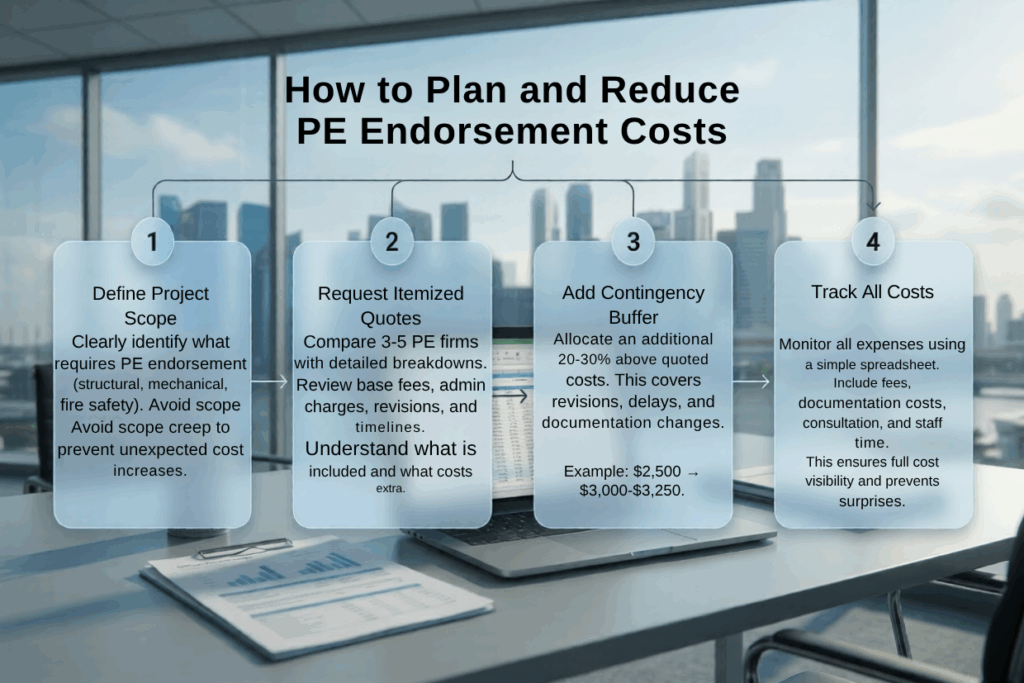
Step 1: Define Your Project Scope Document exactly what requires PE endorsement (structural elements only? mechanical systems too? fire safety?). Scope creep causes budget overruns and surprises mid-project.
Step 2: Request Itemized Quotes from 3–5 PE Firms Don’t accept a flat quote. Ask for a detailed breakdown:
- Base endorsement fee
- Admin charges
- Revision allowances
- Timeline and expedite options
- What’s included vs. what costs extra
Compare across multiple providers. Price variation often reflects differences in service quality, specialization, and hidden costs.
Step 3: Add a Contingency Buffer Budget an additional 20–30% beyond quoted totals. This covers unexpected revisions, additional documentation requests, or processing delays.
Example: A $2,500 quote warrants a $3,000–$3,250 total budget.
Step 4: Track All Related Costs Use a simple spreadsheet listing:
- Base endorsement fee
- Documentation prep costs
- Consultation expenses
- Staff time allocation
- Any additional charges
This prevents budget surprises and reveals where costs are clustering.
Comparing Service Providers and Quotes
| Factor | Low-Cost Providers | Premium Providers |
| Base Endorsement Fee | $800–$1,200 | $1,500–$2,500+ |
| Revision Handling | Limited revisions; extras charged | Multiple revisions typically covered |
| Turnaround Time | 2–3 weeks standard | 5–10 business days (expedited options available) |
| Specialization | General engineering | Sector-specific expertise (structural, industrial, fire safety, etc.) |
| Compliance Risk | Higher risk of initial rejection | Lower rejection rates, smoother approvals |
| Support & Consultation | Minimal guidance; you prepare docs | Guided consultation, prep support included |
| Total Realistic Cost | $2,000–$2,800 | $2,500–$4,500 |
Key insight: Lower cost doesn’t mean better value. Low-cost providers may lack sector expertise, increasing revision cycles and project delays. Premium providers often deliver faster approvals and fewer surprises, offsetting higher upfront fees.
Case Examples and Lessons Learned
The Budget Error: Clementi Tech Park Project
A small structural contractor budgeted $1,500 for PE endorsement on a mechanical installation project. They significantly underestimated document preparation costs and revision cycles.
Outcome:
- Initial quote: $1,500
- Actual cost: $3,200
- Project delay: 3 weeks
- Root cause: No contingency buffer; chose lowest-cost provider without checking specialization
The Smart Plan: Bukit Batok Manufacturing Site
A similar project budgeted strategically:
- Base endorsement: $2,000
- Document prep: $600
- Contingency (20%): $520
- Total budget: $3,120
They selected a provider known for transparent communication and sector expertise in industrial systems.
Outcome:
- Endorsement received in 10 business days
- Final cost: $2,850 (under budget)
- Zero revision cycles
- Project completed on schedule
The lesson: Realistic budgeting + transparent provider selection prevents surprises and delays.
Pros, Cons, and Trade-Offs
Paying More for Speed
Expedited PE endorsement reviews cost 30–50% more but save 1–2 weeks.
Worth it if: Project delays create operational disruptions, client penalties, or cascading costs.
Not worth it if: Your timeline is flexible and you’re managing costs tightly.
Doing It Yourself (Preparing Documents In-House)
Self-preparing documentation to reduce consultation costs seems attractive. It often backfires.
Common outcome: Rejected submissions due to incomplete or incorrect documentation extend timelines and increase total costs beyond what outsourcing would have cost.
Recommendation: Outsource documentation prep if your team lacks prior PE endorsement experience.
Risk vs. Cost
Choosing an under-qualified or unregistered “PE provider” to save money risks:
- Project rejection and full restart
- Legal liability and compliance penalties
- Damage to professional reputation
Regulatory non-compliance isn’t worth the savings.
Industry platforms like Singapore Demolition Hackers often publish transparent cost breakdowns and PE endorsement case studies, offering valuable context on typical expense ranges and process timelines across different project types. These resources help applicants benchmark their budgets against real-world examples and understand sector-specific variations.
Next Steps for Managing PE Endorsement Costs
Practical Checklist for Applicants
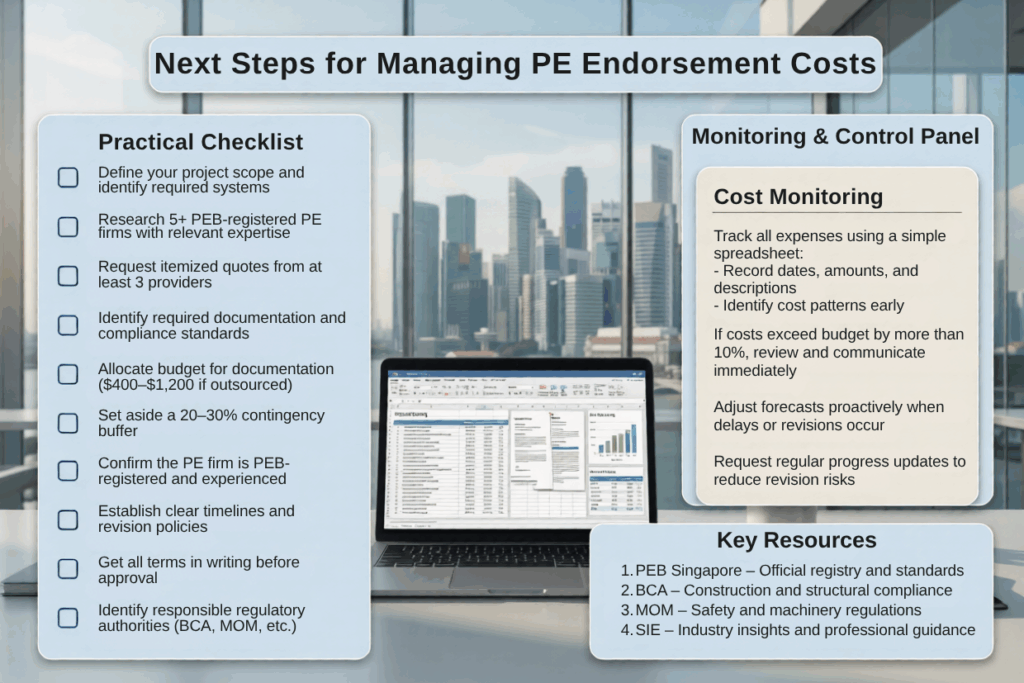
- Define your project scope and identify which systems require PE endorsement
- Research and list 5+ PEB-registered PE firms with sector expertise in your industry
- Request itemized quotes with cost breakdowns from at least 3 providers
- Identify all required documentation and BCA compliance standards (if applicable)
- Allocate budget for documentation prep ($400–$1,200 if outsourcing)
- Set aside a 20–30% contingency buffer above quoted costs
- Confirm the PE firm is PEB-registered and has proven experience in your sector
- Establish a clear timeline, revision policy, and fee structure before signing
- Get all terms in writing (what’s included, what costs extra, timeline expectations)
- Identify the responsible regulatory body (BCA, MOM, or sector-specific) and any additional approvals needed
How to Monitor and Review Costs During Projects
Track all invoices and expenses in a simple spreadsheet. Note dates, amounts, and descriptions. This creates visibility into where costs are clustering and helps identify unexpected charges early.
If costs exceed budget by more than 10%, communicate with your PE provider immediately to understand why. Some variations are normal, but significant overruns warrant clarification and adjustment.
Adjust budget forecasts proactively if delays occur or additional documentation is requested. Don’t wait until project completion to identify cost overruns.
Request progress updates at agreed intervals. Many PE firms can provide informal reviews or preliminary feedback before submitting for final endorsement, reducing revision risk.
Resources for Ongoing Learning
- Professional Engineers Board (PEB) Singapore (peb.gov.sg): Official registry, registration requirements, and PE endorsement standards
- Building and Construction Authority (BCA) (bca.gov.sg): Structural and construction-related requirements; structural design endorsement guidelines
- Ministry of Manpower (MOM) (mom.gov.sg): Occupational safety and machinery compliance requirements
- Singapore Institution of Engineers (SIE): Industry forums and professional networks for peer insights on realistic costs and timelines
Frequently Asked Questions About PE Endorsement Fees
Q : How long does a PE endorsement take in Singapore?
A : Standard turnaround is 2–3 weeks. Expedited reviews (if available) take 5–10 business days but cost 30–50% more. Actual timing depends on documentation completeness and the PE firm’s workload. Incomplete submissions add 1–2 weeks for resubmission and re-review cycles.
Q : Can I use a PE from another country for endorsement in Singapore?
A : No. PE endorsement in Singapore requires a PEB-registered professional engineer. Foreign-trained engineers must first obtain Singapore Professional Engineer registration through the PEB, which involves additional qualification assessments and costs. Using an unregistered PE invalidates the endorsement and may trigger regulatory penalties.
Q : What happens if my PE endorsement application is rejected?
A : Rejections typically result from incomplete documentation, non-compliance with standards, or using an unqualified PE. You must resubmit with corrections, which adds 1–3 weeks and additional fees (usually 30–50% of the original endorsement fee). Avoiding rejection saves significant time and money, invest in proper documentation prep upfront.
Q : Are PE endorsement fees tax-deductible in Singapore?
A : PE endorsement and related professional consultation fees are generally deductible as project or business expenses. Consult with your accountant or tax advisor to confirm applicability to your specific situation, as treatment varies by business entity type and project classification.
Q : Do all engineering projects require PE endorsement in Singapore?
A : No. Requirements vary by project type and sector. BCA mandates PE endorsement for structural designs in buildings above certain thresholds and fire safety systems. Industrial machinery and hazardous systems require MOM or sector-specific approvals. Small residential or minor renovation projects may not require endorsement. Check with the relevant regulatory body early to confirm requirements for your specific project.
Conclusion
PE endorsement fees in Singapore extend far beyond the base professional fee. Hidden costs in documentation, consultation, revisions, and delays often double or triple the initial quote if you’re not prepared.
Key takeaways:
- PE endorsement fees include multiple hidden costs beyond the base professional charge
- Proper budgeting with contingency buffers prevents delays and financial surprises
- Knowledge of regulatory requirements (PEB, BCA, MOM) and realistic cost structures empowers informed decisions
- Selecting experienced, PEB-registered PE firms based on transparency and specialization, not just price, yields better outcomes
Your next action: Use the practical checklist above to define your project scope, gather itemized quotes from at least 3 PEB-registered providers, and allocate a realistic budget with a 20–30% contingency buffer.
This approach transforms PE endorsement costs from a source of surprise and delay into a manageable, predictable project expense that you can plan for with confidence.