

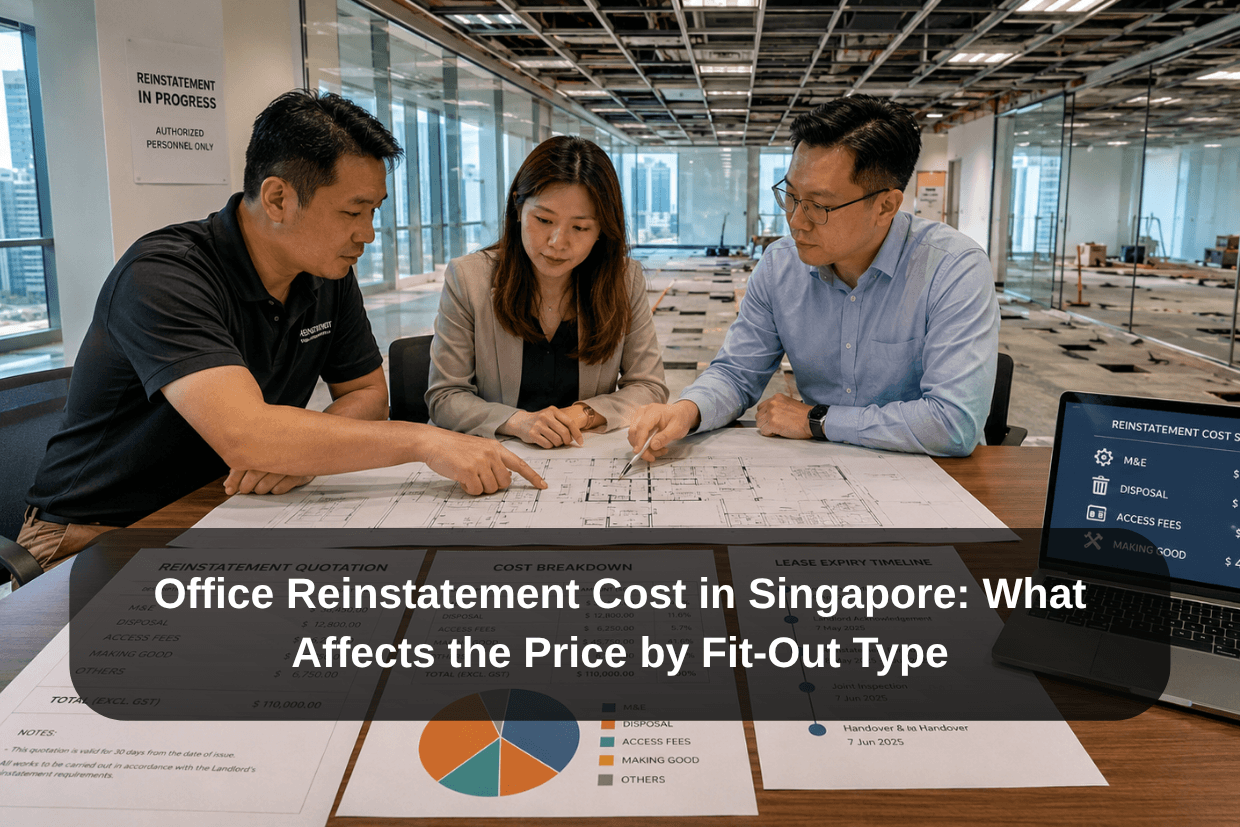
What Drives Office Reinstatement Cost: The Six Key Variables
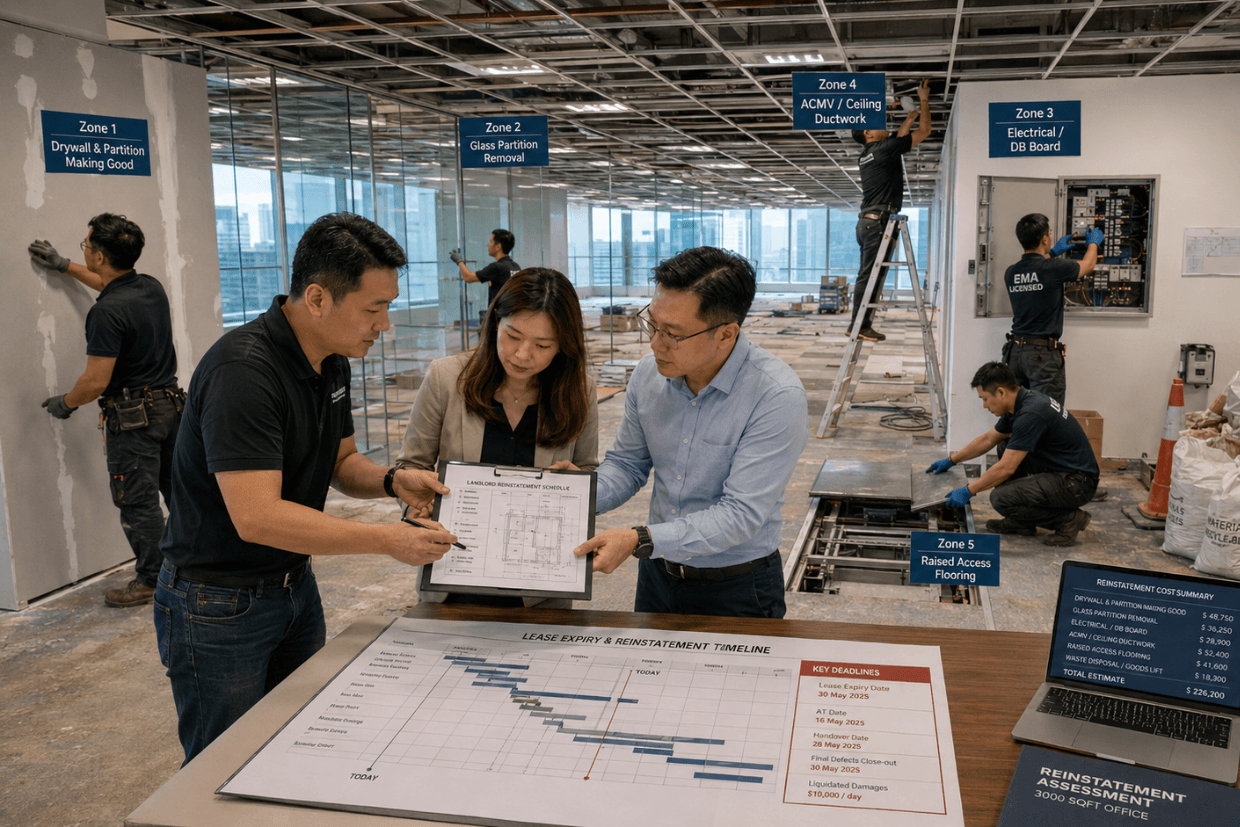
Variable 1: The Reinstatement Schedule Scope
The landlord’s reinstatement schedule is the primary cost document. It specifies every element to be removed and every surface to be restored. Requesting it as early as possible, rather than waiting for formal issuance, creates accurate planning time.
Variable 2: Fit-Out Construction Type
The materials and construction methods used in the original fit-out determine removal complexity. Drywall partitions cost less to remove than glass partitions. Glass partitions cost less than floor-to-ceiling demountable systems with integrated electrical. Each type requires different labour, equipment, and disposal.
Variable 3: Mechanical and Electrical Scope
M&E restoration covers three distinct scopes: removing electrical modifications back to the original distribution point, restoring the distribution board (DB board) configuration, and returning ACMV (air conditioning, mechanical, and ventilation) systems to their pre-tenancy state. Each requires licensed specialists. All three require coordination with the base building maintenance team.
Variable 4: Raised Flooring and Specialist Floor Systems
Raised access flooring, common in technology and financial sector offices, costs significantly more to remove per sqm than standard flooring because each panel and pedestal must be individually extracted, the sub-floor must be assessed and restored, and the material volume for disposal is substantially higher.
Variable 5: Disposal Volume and Building Access Conditions
NEA regulations require construction waste to be disposed of through licensed contractors, charged by weight and trip. High-specification fit-outs generate far more waste volume than basic ones. CBD commercial buildings impose access fees, goods-lift restrictions, and limited working hours, all of which increase the total project spend.
Variable 6: Timeline Pressure and Programme Duration
A compressed timeline increases the price. When multiple trades work simultaneously to meet a lease expiry date, overtime rates apply, more supervision is required, and more access days must be booked in parallel. A six-week programme at standard rates consistently costs less than a two-week accelerated programme for the same scope.
Office Reinstatement Cost by Fit-Out Type
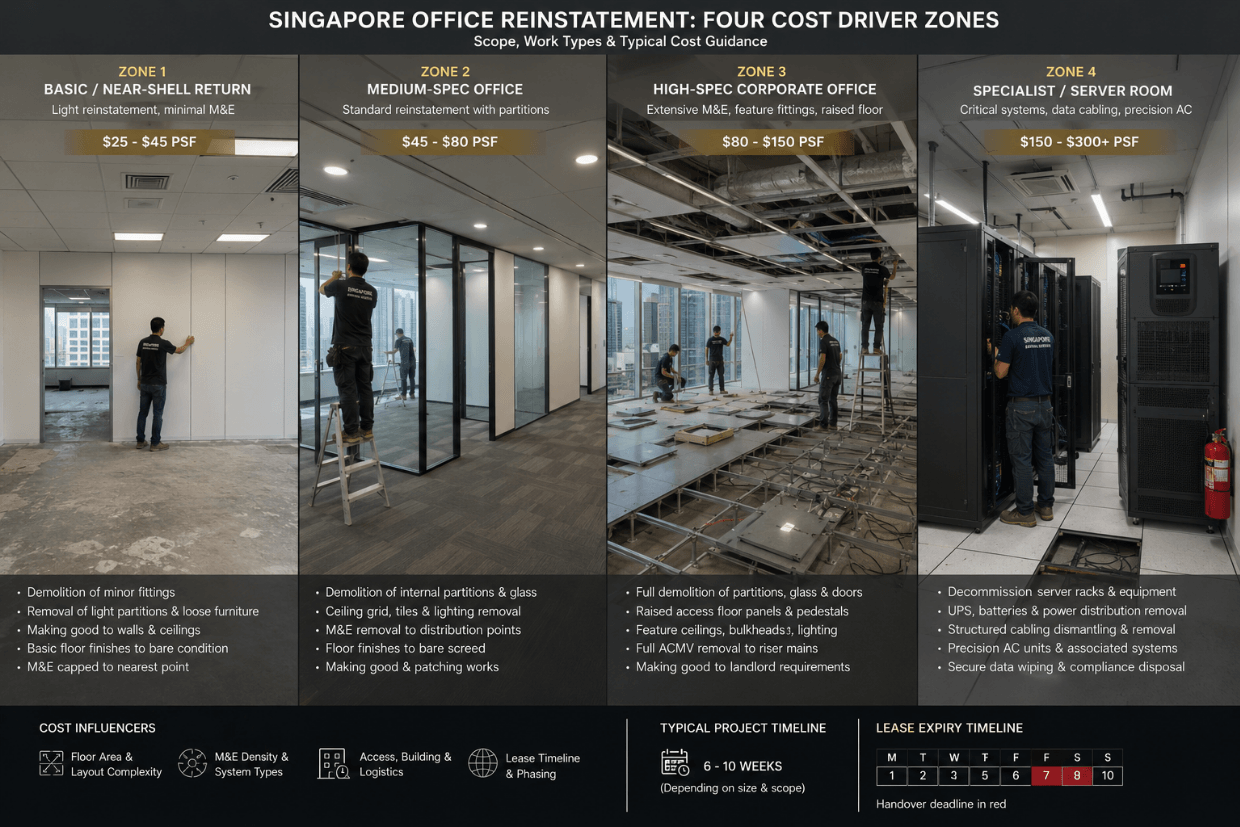
The table below provides indicative cost ranges by fit-out type for a 3,000 sqft office in Singapore. Actual figures depend on the specific schedule and site conditions.
Fit-Out Type | Indicative Cost Range | Typical Duration | Primary Cost Drivers |
Basic or near-shell return | $15,000 to $40,000 | 1 to 2 weeks | Light partitions, surface making good |
Standard medium specification | $40,000 to $100,000 | 2 to 4 weeks | Glass partitions, M&E modifications, and ceiling |
High-specification full fit-out | $100,000 to $220,000+ | 3 to 6 weeks | Raised flooring, full M&E, glass, specialist disposal |
Server room or specialist use | Add $50,000 to $150,000+ | 2 to 4 weeks additional | Specialist decommissioning, licensed sub-contractors |
Type 1: Basic Reinstatement (Near-Shell Return With Minimal Fit-Out)
What Basic Reinstatement Typically Involves
Offices with simple drywall partitioning, standard suspended ceiling, basic electrical modifications, and no raised flooring. The scope typically includes: removing partitions, restoring the ceiling grid, returning electrical points to their original configuration, and making good all surfaces.
Indicative Cost Range and What It Includes
The indicative range for a 3,000 sq ft basic office is $15,000 to $40,000. This includes labour, basic disposal, surface preparation, and electrical sign-off. Building access fees and specialist sub-contractor works are generally excluded and should be confirmed explicitly.
Type 2: Standard Office Reinstatement (Medium-Specification Fit-Out)
What Medium-Spec Offices Typically Include
The most common type in Singapore’s commercial market: a mix of drywall and glass partitions, custom ceiling layout, upgraded lighting, and a reception area. The scope is more complex because it involves multiple partition types, more electrical sub-circuits, and more surface area requiring making good.
Indicative Cost Range and Key Cost Drivers at This Level
The indicative range for a 3,000 sq ft medium-spec unit is $40,000 to $100,000. The elements that push toward the upper end are glass partition volume, extensive ceiling modifications, and the number of enclosed meeting rooms, each requiring a full envelope of removal and surface restoration.
Type 3: High-Specification Office Reinstatement (Full Corporate Fit-Out)
What High-Spec Fit-Outs Typically Include: Glass, Raised Flooring, Feature Ceilings
Financial services, technology, and professional services firms typically occupy this category. Characteristics include extensive glazed partitioning, raised access flooring across the tenancy, feature ceilings, ACMV modifications, custom joinery, and high-density electrical and data infrastructure.
Indicative Cost Range and What Makes This Category Expensive
The indicative range for a 3,000 sq ft high-spec unit is $100,000 to $220,000, or more. The three highest components are raised flooring removal, full M&E restoration, and glass disposal volume. Each involves specialist labour, licensing requirements, and disposal that do not scale with floor area.
Type 4: Data Centre, Server Room, and Specialist Use Reinstatement
Why Server Room Decommissioning Is Treated as a Specialist Scope
Decommissioning a tenant-installed server room involves specialist electrical work, removal of UPS systems and precision air conditioning, raised flooring in the server zone, structured cabling removal, and often fire suppression system deactivation. These works require specialist sub-contractors whose coordination adds time and spend beyond the standard project programme.
Indicative Cost Range and Specialist Requirements
Server room decommissioning typically adds $50,000 to $150,000 or more to the standard scope cost, depending on equipment installed and base building connection complexity. Identifying this scope early is essential to accurate planning.
Cost Breakdown by Work Type: What Each Element Typically Costs
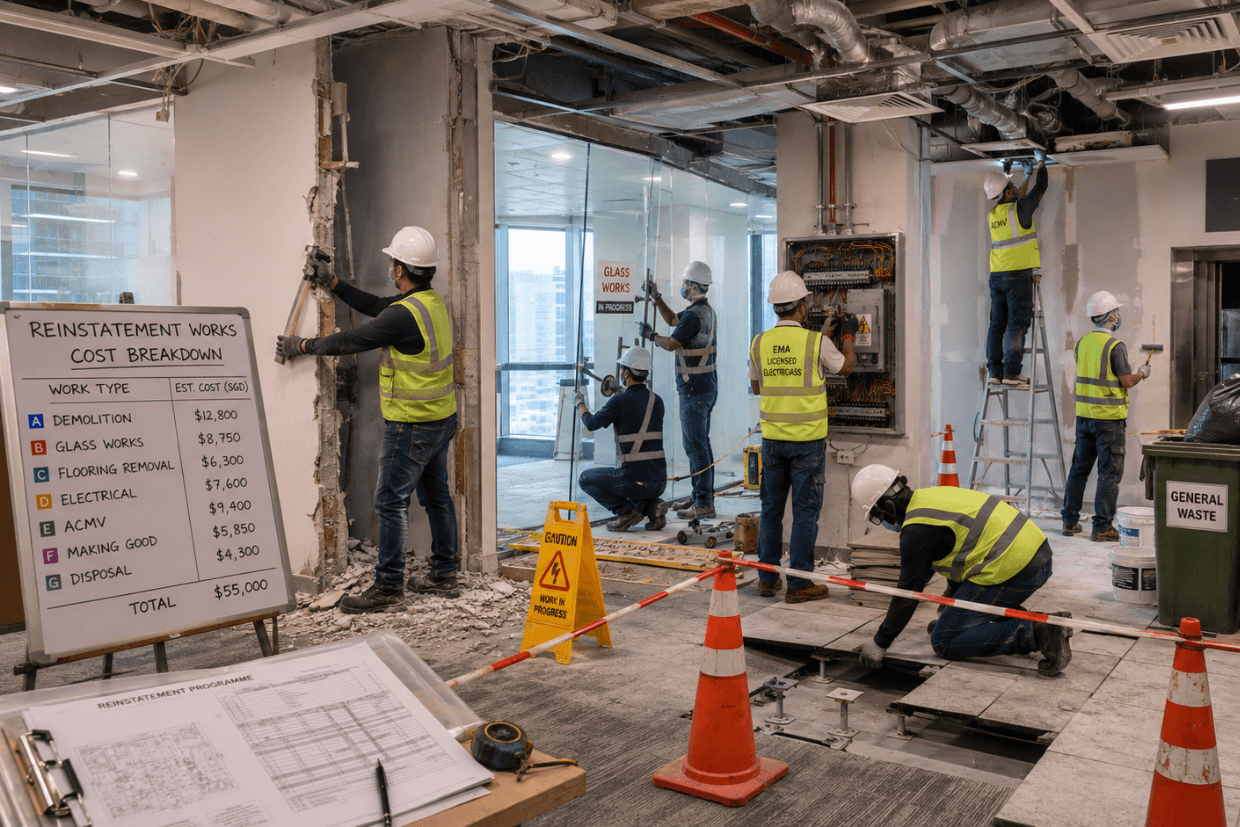
Hacking and Demolition Costs
Hacking works are priced by linear metre of partition or by area of floor or ceiling demolished. Concrete and masonry cost more to hack than lightweight drywall. Dust containment in occupied adjacent spaces adds further to the bill.
Partition and Ceiling System Removal
Drywall removal is the least expensive partition type. Glass partition dismantling costs two to three times more per linear metre than drywall when labour and disposal are combined. Ceiling systems with custom tile layouts or feature elements cost more than standard suspended grid removal.
Raised Flooring Removal: What It Costs and Why
Raised access floor removal is priced per panel and pedestal, not per sqm. Sub-floor restoration adds a further variable that may not be fully knowable until the panels are lifted. Budget for sub-floor making good as a contingency item.
Glass Partition Dismantling vs Drywall Removal
Glass partition dismantling costs two to three times more per linear metre than drywall removal. Glass disposal is classified as waste and must be handled by licensed contractors, adding a separate disposal line.
Mechanical and Electrical Restoration Costs
M&E restoration requires EMA-licensed electricians and produces documentary sign-off evidence for the landlord. ACMV restoration requires coordination with the base building maintenance contractor and cannot be accelerated once that process begins.
Making Good: What It Costs and What It Covers
Making good to a “paintable standard” is specified differently from “original condition.” The landlord’s schedule defines which applies. Underestimating the making-good standard is one of the most consistent causes of failed handover inspections.
Waste Disposal and Licensed Disposal Contractor Costs
Construction waste disposal follows NEA’s licensed contractor requirements. For a high-spec project, disposal can represent 15 to 25 %of the total project spend. Buildings that restrict trip frequency compound the disposal component significantly.
How to Get an Accurate Office Reinstatement Quotation in Singapore

What to Provide to a Contractor for a Reliable Quotation
Five documents produce an accurate project quotation: the landlord’s reinstatement schedule, the current floor plan, original fit-out drawings, the building’s contractor access policy, and the remaining lease timeline. A quotation given without all five is an estimate, not a price.
What a Quotation Should Itemise: Red Flags and Green Flags
A well-structured quotation itemises by work category, states waste disposal as a separate line, explicitly includes or excludes access fees, identifies specialist sub-contractor works, and states a timeline. A lump-sum quotation with no breakdown, no waste disposal line, and no reference to electrical certification should prompt you to request a full itemised breakdown before proceeding.
Why Three Quotations at Different Prices May All Be Accurate
Three contractors looking at the same scope may quote $50,000, $85,000, and $130,000. Each may be accurate. Differences arise from different assumptions about access conditions, different interpretations of the making-good standard, and different inclusion or exclusion of specialist works. Request a scope confirmation meeting with each before selecting.
Singapore Demolition Hackers N Removals is a contractor with bizSAFE Level 3 certification that issues office project quotations mapped line by line to the landlord’s reinstatement schedule, with specialist sub-contractor scope and disposal presented as distinct items rather than absorbed into a lump sum.