

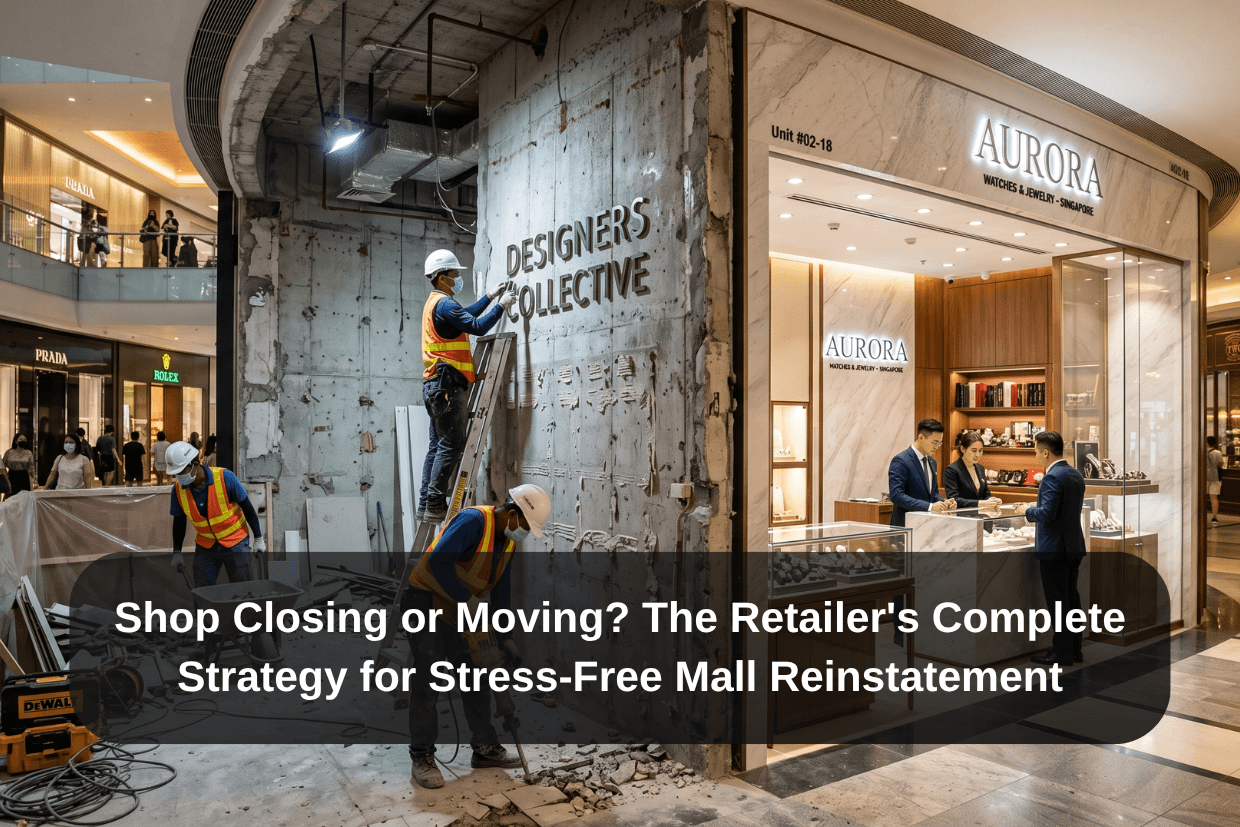
What Retail Shop Reinstatement Actually Means Under Singapore Leasing Law
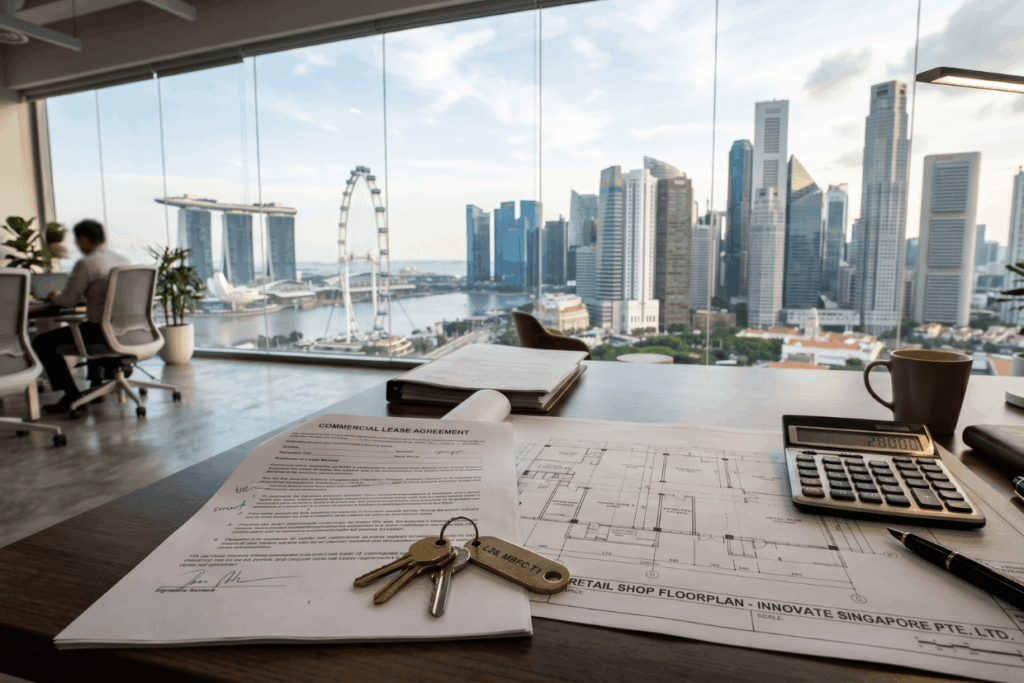
The Legal Definition of Reinstatement in a Commercial Lease
Reinstatement means restoring the leased unit to the condition it was in when the landlord delivered it to you, not to a general standard of cleanliness, and not to the condition the previous tenant left it in. The legal benchmark is the handover condition documented at the start of your tenancy. That document is the reference point for every dispute that follows.
What “Original Condition” Means for Mall Units Specifically
Mall landlords in Singapore typically deliver retail units as a bare concrete shell. The standard shell specification includes bare concrete floors, unpainted or base-coat walls, capped mechanical and electrical points, and no false ceiling. Every element installed beyond that shell, by you, your fit-out contractor, or your interior designer, is your responsibility to remove at lease end.
What a Retail Tenant Is and Is Not Responsible For
You are responsible for removing everything you installed: partitions, flooring, ceilings, built-in display units, lighting, signage, M&E additions, and branding. The landlord is responsible for structural defects that pre-dated the tenancy and for fair wear and tear, surface degradation that occurs through normal use over time.
The grey area that generates the most disputes involves work that the landlord approved during your fit-out stage, but that you installed. Landlord approval of a fit-out does not automatically waive the reinstatement obligation. Check your lease clause specifically; some leases include an approved-works schedule that modifies reinstatement scope; most do not.
How the Reinstatement Clause Differs Across Singapore Mall Landlords
Major Singapore mall landlords, including CapitaLand, Frasers Property, and Mapletree, each embed reinstatement requirements in their own lease templates. Some mall landlords require work to be carried out by their approved contractors only. Others mandate a pre-reinstatement inspection before any works begin. Reading the specific clause in your lease, not a generic guide, is the only reliable starting point. The Singapore Business Federation’s tenancy resources provide general commercial leasing guidance for retail tenants navigating exit obligations.
The Scope of a Retail Shop Reinstatement: What Needs to Come Out
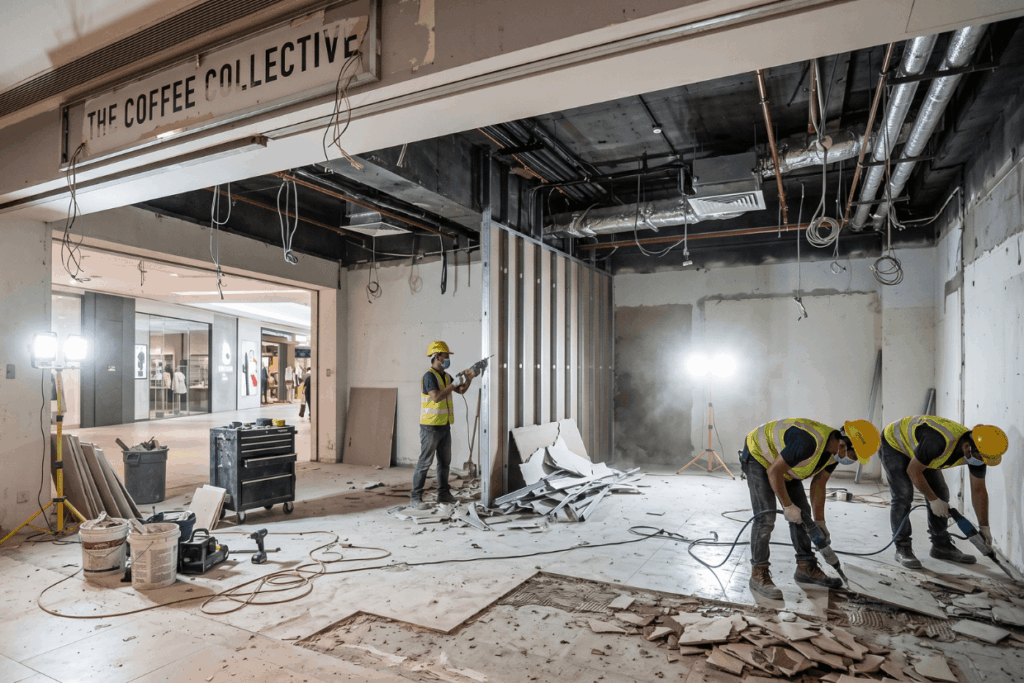
Once you understand what your lease requires and what “original condition” means for your specific unit, the next question is practical: what exactly needs to come out, and in what sequence?
Structural and Interior Dismantling Works
All internal partitions, feature walls, and display structures built into the unit shell must be removed. Customised flooring, timber, tiles, vinyl, and raised platforms must come back to the original screed or concrete level. False ceilings, lightboxes, and decorative soffits are tenant-installed and must be dismantled.
Mechanical and Electrical (M&E) Restoration
Any electrical distribution boards and wiring added during your tenancy must be removed, and the original capping reinstated. Additional air-conditioning systems, fan coil units (FCUs), and ducting beyond the landlord’s base provision must be taken out. For F&B tenants, this extends to all plumbing additions: grease traps, additional sink drainage, and dedicated water supply runs. Sprinkler system modifications are a consistently overlooked cost trigger. If your fit-out required the sprinkler layout to be altered, reinstating it to the original design requires a licensed fire protection contractor, not your general reinstatement crew.
Signage and Branding Removal
Shopfront signage, lightboxes, LED channel letters, and acrylic panels must be fully removed. Internal branding installations, including wall graphics, frosted vinyl, and feature murals,s fall within the reinstatement scope. Making good after removal is not optional: holes must be patched, surfaces plastered, and paint matched to the landlord’s specification.
What “Making Good” Means in Practice
Making good is not cosmetic tidying. It means returning surface finishes to a standard that passes the landlord’s inspection, and landlords with premium mall management teams apply that standard rigorously. In practice, this can mean full wall skimming rather than patching, floor grinding where adhesive-bonded flooring has left residue, and screeding where the original floor level was altered. Contractors who quote only for demolition and leave out making good will leave you with a snagging list and an additional invoice.
The Mall Reinstatement Process: A Step-by-Step Retailer’s Guide
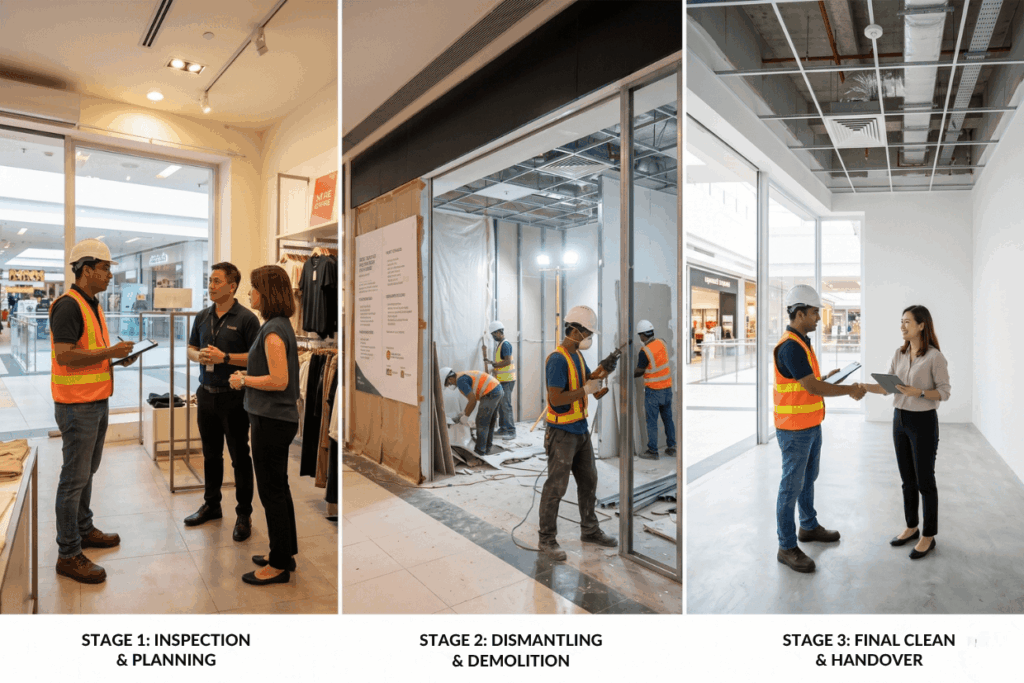
Knowing the scope is one thing. Executing it without triggering a deposit dispute or a stop-works notice from mall management requires a process that most retailers have never been through before.
Step 1: Read and Extract the Reinstatement Clause Before You Do Anything Else
Read the reinstatement clause word by word. Terms like “reinstate,” “restore,” “make good,” and “original condition” each carry specific contractual meanings that directly affect your scope and cost. Check whether landlord approval is required for your reinstatement contractor. Check whether a method statement or reinstatement schedule must be submitted before works begin.
Step 2: Request the Original Handover Condition Report and As-Built Drawings
The handover inspection report documents the unit’s condition when you took possession. If you did not retain your copy, request it from the landlord; they are required to hold it. As-built drawings from your fit-out stage define what was added versus what was original. Without both documents, scoping the reinstatement accurately is guesswork.
Step 3: Conduct a Pre-Reinstatement Site Assessment
Walk the unit with your contractor before any works begin, not after you have vacated. Identify which elements are clearly tenant-installed versus landlord-provided. Photograph any pre-existing damage that was present at handover. Without that photographic record, any damage found after reinstatement will default to the tenant’s account, regardless of when it actually occurred.
Step 4: Engage a Specialist Reinstatement Contractor Early
Retail shop reinstatement is not a general renovation. It requires controlled demolition, selective strip-out, M&E reinstatement to specification, and making good to a standard that passes landlord inspection. Most Singapore mall leases require reinstatement to be completed within 7 to 14 days of lease expiry. That compressed timeline, combined with mall work permit lead times, means engaging a contractor 6 to 8 weeks before lease end is not a recommendation; it is a practical minimum.
Step 5: Obtain Mall Management Approval for Works
Singapore malls require work permits and method statements before demolition begins. Approved working hours are typically restricted to non-trading periods, early morning or late night shifts. Noise and dust control requirements in enclosed mall environments are enforced by mall operations teams, who will shut your work down if standards are not met. A contractor unfamiliar with your specific mall’s compliance process will cost you time at exactly the point where delay is most expensive.
Step 6: Execute Works, Document Throughout, and Request Landlord Sign-Off
Photograph and video-record the completed reinstatement before handover. Request a joint inspection with the landlord’s representative immediately after the works are complete. Obtain a written sign-off or a formal snagging list with itemised requirements. Do not accept verbal clearance; it has no evidentiary value if the deposit dispute comes six weeks later.
The 5 Mistakes That Cost Retailers Their Full Deposit

Mistake 1: Starting Reinstatement Planning in the Final Month
Works, approvals, and contractor availability require a minimum of 6 to 8 weeks. Starting in the final month means compressing a multi-stage process into a window that cannot accommodate it. Urgency premiums of 20 to 40 per cent are standard when contractors are engaged at the last minute, and rushed works produce incomplete reinstatement.
Mistake 2: Using a General Renovation Contractor Instead of a Reinstatement Specialist
The problem with using a general renovation contractor is not that the work is necessarily poor; it is that the contractor does not know what the mall management office expects. That gap shows up in the inspection. Rejected M&E reinstatement, incomplete making good, and wrong working hours are the three most common reasons a landlord brings in their own contractor to “complete” the works. At that point, you have no control over who they appoint or what they charge. The full cost comes off your deposit at rates you never agreed to.
Mistake 3: Not Documenting the Pre-Reinstatement Condition
Without a photographic record before demolition begins, there is no evidence base to dispute pre-existing damage claims. Any damage found after reinstatement will be charged to you by default. The landlord does not need to prove you caused it; you need to prove you did not. Without photographs, that argument is impossible to make.
Mistake 4: Assuming Wear and Tear Covers More Than It Does
Fair wear and tear applies to surface degradation from normal use: minor scuff marks, small nail holes, and light paint fading. It does not cover structural alterations, M&E additions, built-in display units, or any element you added. Landlords routinely invoice for items tenants assumed were covered under normal wear, and under most Singapore commercial lease templates, the landlord’s interpretation is the one that prevails.
Mistake 5: Handing Back Keys Before Getting Written Sign-Off
Once keys are returned, practical leverage in any deposit dispute disappears. A snagging list issued after key return gives the landlord sole discretion over remediation scope, contractor selection, and cost. What might have been a S$500 patching job becomes a S$3,000 landlord-contractor invoice. Get a written sign-off before the keys leave your hand.
What to Do If the Landlord Disputes Your Reinstatement

Even retailers who plan carefully and execute properly sometimes face pushback from landlords at handover. Knowing what the dispute process looks like and what gives you leverage in it matters before the dispute arises, not after.
Understanding the Deposit Dispute Process in Singapore
Singapore’s Small Claims Tribunal handles tenancy-related disputes up to S$20,000. For disputes above this threshold, the process escalates to civil proceedings in the State Courts. Documentation, the original handover report, photographic evidence of completed reinstatement, and written landlord correspondence, is the primary evidence base. Without it, a legitimate dispute becomes very difficult to sustain.
When to Engage a Lawyer vs When to Negotiate Directly
Legal engagement is appropriate when the disputed amount is material, and your documentation clearly supports your position. Most retail tenancy deposit disputes in Singapore are resolved through direct negotiation, but only when the tenant has a documentary record that makes the landlord’s position difficult to sustain. Without documentation, negotiation has no leverage.
How to Protect Yourself Before the Dispute Arises
Request written confirmation from the landlord’s representative at each stage of the reinstatement process, not only at final handover. Keep all contractor invoices, work permits, method statements, and email correspondence. The BCA’s guidelines on approved renovation and reinstatement works provide the regulatory framework within which all commercial reinstatement work in Singapore must be conducted.