


Is Your Renovation Legal? 5 Scenarios Where You Absolutely Need a PE Endorsement

The Renovation Mistake That Costs More Than the Renovation Itself

Stop-Work Orders Happen More Often Than Homeowners Expect

A renovation that starts without the correct regulatory approvals can be halted by the Building and Construction Authority (BCA) at any stage, including after it is finished. When a Stop Work Order lands, all work ceases immediately. What follows is reinstatement: the homeowner must strip out completed works, restore the original structural condition, and pay contractor fees a second time. The cost regularly runs into the tens of thousands of dollars. A PE endorsement for a standard residential project, by comparison, typically costs between S$1,500 and S$5,000. The arithmetic is not subtle.

Why Singapore Renovation Law Is Stricter Than Most Residents Assume

Singapore’s housing stock is predominantly high-density. In a multi-storey building, structural elements do not belong to one unit; they carry loads from multiple floors and are shared across boundaries. A wall that looks like it belongs entirely to your flat may be supporting three storeys above it. This interdependency is why the law requires independent professional verification for certain renovation works, and why “my contractor said it’s fine” has no legal standing when the BCA inspects.

What Is a PE Endorsement and Why Does It Exist?
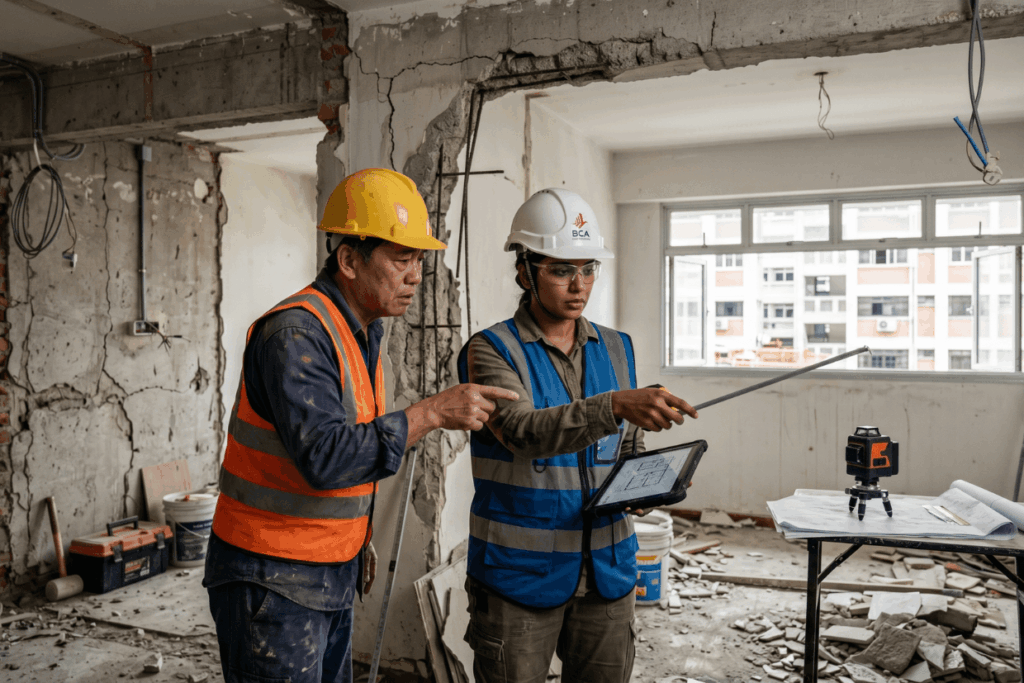
Defining a Professional Engineer in Singapore’s Built Environment

A Professional Engineer (PE) in Singapore is registered with the Professional Engineers Board (PEB), which regulates the profession under the Professional Engineers Act. In the context of renovation and demolition, the relevant discipline is civil and structural engineering. When a PE endorses structural works, that professional is accepting legal and personal responsibility for the structural assessment; it is not an advisory sign-off; it is certification with professional liability attached.

The Purpose of the PE Endorsement Requirement

The endorsement requirement exists under the Building Control Act (Cap. 29), enforced by the BCA. Its function is straightforward: to ensure that renovation works do not compromise the structural integrity of any part of a building, including elements shared with neighbouring units and common areas. Without this requirement, high-density residential buildings would be structurally vulnerable to undocumented alterations by individual owners, with no professional accountability for the consequences.

PE Endorsement vs Architect Approval: What’s the Difference?

Architects handle planning and design compliance, including URA approvals for use changes and external facade alterations. PEs certify structural safety. Both address different aspects of the same project, and complex renovations may require both. The most common and costly confusion among Singapore homeowners is treating URA planning clearance as equivalent to BCA structural clearance. They are separate frameworks with separate approval chains.

Permitted Works vs Structural Works: Where the Line Is Drawn

The Building Control (Minor Works) Regulations define categories of works that do not require a full plan submission to BCA. These cover genuinely non-structural activities. The moment works affect a structural element, a load-bearing wall, beam, column, or slab, they move outside the minor works category and require either PE endorsement, a full building plan submission, or both. Many homeowners discover this line only after crossing it.

How Singapore’s Property Type Affects Your PE Endorsement Obligations

HDB Flats: Additional Layer of Regulation

HDB flats carry a dual compliance structure. On top of BCA’s requirements, HDB’s own Renovation Guidelines independently restrict works involving structural elements. Hacking structural walls, removing beams, and altering floor slabs are explicitly prohibited without HDB approval. An HDB renovation permit is required before works begin, but receiving that permit does not replace BCA structural clearance, where that is separately required. Both must be satisfied.

Private Condominiums: MCST and BCA Dual Compliance

In private condominiums, the MCST typically requires renovation approval before work begins. That approval governs building management rules and protects shared facilities. What it does not do is assess structural safety. A homeowner who obtains MCST approval but proceeds without PE endorsement for structural works remains fully exposed under the Building Control Act. MCST approval and BCA compliance are not interchangeable.

Landed Properties: Greater Scope, Greater Responsibility

Landed properties do not share party walls in the same way as stacked units, but PE obligations still apply. Works involving foundations, load-bearing structural frames, or significant structural alterations require endorsement regardless. Ground-level and basement works on landed properties frequently implicate soil bearing capacity and foundation integrity, and those are not areas where visual inspection substitutes for engineering analysis.

5 Scenarios Where a PE Endorsement Is Non-Negotiable

Knowing your property type establishes your regulatory baseline. The more specific question most homeowners face is this: which renovation activities actually trigger the endorsement requirement? These five scenarios account for the vast majority of PE endorsement obligations in Singapore residential renovation.

Scenario What Triggers the Requirement Risk Without Endorsement
Removing or modifying a load-bearing wall
Any wall contributing to the structural load path
Structural failure, reinstatement order, criminal liability
Structural hacking or demolition
Hacking that penetrates beams, columns, slabs, or shear walls
Hidden rebar damage, irreversible structural damage
Addition and Alteration (A&A) works
Works altering any structural member
BCA plan rejection, stop-work order
Heavy fixture or floor load installation
Loads exceeding design floor tolerance
Slab deflection, long-term structural deterioration
Works adjacent to structural members
Excavation or vibration near columns or foundations
Foundation destabilisation, neighbour liability

Scenario 1: Removing or Modifying a Load-Bearing Wall

How to Identify a Load-Bearing Wall Before Any Work Begins

Load-bearing walls are identified from structural drawings, not from knocking on walls, visual inspection, or contractor instinct. In older HDB flats and condominiums, as-built drawings sometimes reflect original construction rather than subsequent alterations. A PE reviews the original structural plans and conducts a site assessment to confirm actual load paths before any scope is agreed upon.

The Structural and Legal Risk of Unauthorised Removal

In a multi-storey building, removing a load-bearing wall transfers structural loads to adjacent elements that were never designed to carry them. The resulting damage, cracking, deflection, and partial structural failure can affect multiple floors and neighbouring units. BCA enforcement under the Building Control Act includes fines, reinstatement orders, and, in serious cases, criminal prosecution of the property owner.

Scenario 2: Hacking and Demolition Work That Involves Structural Elements

What Legally Qualifies as Structural Hacking

Hacking that penetrates or alters beams, columns, reinforced concrete slabs, or shear walls is structural work regardless of scale. A single core drill through a post-tensioned slab, done without prior structural assessment, can sever pre-stressed cables embedded within, causing damage that cannot be undone.

Why Surface-Level Hacking Can Have Sub-Surface Consequences

Post-tensioned slabs are common in Singapore private condominiums built since the 1990s. The steel cables inside are under enormous tension and are invisible from the surface. Singapore Demolition Hackers N Removals is one example of a specialist contractor that coordinates PE sign-off for hacking works as part of the demolition scoping process, specifically to identify these hidden structural risks before any tool makes contact with the slab.

Scenario 3: Addition and Alteration (A&A) Works That Affect Structural Members

Defining the Scope of A&A Works Under Singapore Building Regulations

A&A works that alter, remove, or introduce structural members require a building plan submission to BCA. This applies to merging two rooms by opening up a concrete wall, widening doorways in reinforced concrete frames, and creating new structural openings in external walls of landed properties.

Common A&A Scenarios That Cross into PE Territory

The scope trigger catches many homeowners off guard. Enlarging a kitchen doorway in a concrete-framed condominium, or removing the wall between a living room and bedroom in an HDB flat both require structural assessment. The works look cosmetic from the outside. Structurally, they are not, and the BCA treats them accordingly.

Scenario 4: Installing Heavy Fixtures or Significantly Increasing Floor Load

What Counts as a Load-Sensitive Installation

Residential floors in Singapore are typically designed to a live load tolerance of approximately 1.5 to 2.0 kN/m². Indoor water features, large fish tanks, heavy stone flooring, and concentrated gym equipment can exceed localised floor capacity. The critical factor is not just total weight; it is load concentration over a small area relative to slab and beam design.

Why a Structural Assessment Is Required Before Installation

Load distribution analysis determines whether the existing structure can absorb the additional demand. Where it cannot, the PE specifies structural remediation before installation proceeds. Proceeding without this assessment exposes the homeowner to long-term slab deterioration and to liability for any resulting damage to the unit below. Endorsement is required before the works begin, not after the installation reveals a problem.

Scenario 5: Renovation Work Adjacent to Structural Columns, Beams, or Foundation Elements

Defining Proximity Risk in Structural Terms

“Near” a structural element carries an engineering definition, not just a visual one. Excavation within the zone of influence of a foundation, vibratory works next to columns, and ground disturbance near pile caps can all affect the load transfer between structure and soil, even if the works never physically touch the structural element itself.

Why Proximity Work Still Requires a Structural Assessment

For landed properties in particular, basement-level works and perimeter landscaping excavations regularly intersect with foundation systems. Bearing capacity, lateral support, and settlement behaviour all fall within the scope of a structural review, considerations that are entirely invisible without engineering analysis. The BCA’s requirements for endorsement in these scenarios exist for exactly this reason.

What Happens If You Proceed Without a PE Endorsement?
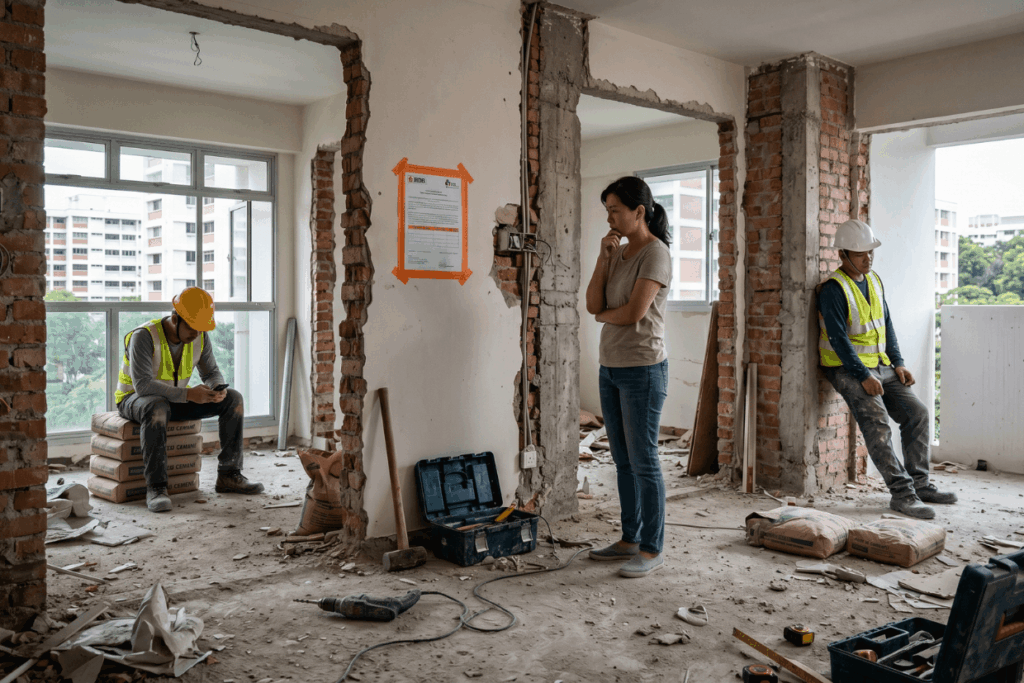
Legal Consequences Under the Building Control Act

Under the Building Control Act, carrying out structural works without required approvals is a criminal offence. Property owners, not contractors alone, face fines and potential prosecution. The law places compliance responsibility squarely with the person who owns the unit.

Stop-Work Orders, Demolition Orders, and Reinstatement Costs

A BCA Stop Work Order requires immediate cessation of all works on site. If unauthorised structural works are confirmed, the BCA can escalate to a Demolition Order, requiring the owner to remove the works and restore the original structural condition. Every dollar of that cost comes from the owner’s pocket.

Impact on Property Resale, Valuation, and Mortgage

Non-compliant structural works must be declared in property transactions. Banks may decline to finance the purchase of a property carrying unresolved BCA notices. CPF funds cannot be used for properties with outstanding structural compliance issues. What began as a renovation decision can follow a property through multiple sales.

Insurance Voids and Personal Liability

Standard home and building insurance policies in Singapore typically exclude damage arising from unauthorised structural works. If hacking or demolition without PE endorsement causes structural damage to a neighbouring unit, the homeowner has no insurance coverage and faces direct personal liability. There is no policy to claim against.

How to Get a PE Endorsement: The Process Step by Step

Step 1: Engage a Qualified Structural PE Registered with PEB

Verify the PE’s registration on the PEB’s public register before any engagement. Confirm the discipline is civil and structural, and that the PE’s scope of practice covers the type of work you are planning. Do not assume that a recommendation from a contractor constitutes adequate verification.

Step 2 Structural Assessment and Drawing Preparation

The PE starts by reviewing the property’s existing structural drawings, and this is where the process often hits its first obstacle. Older HDB flats and condominiums built before the 1990s frequently have incomplete or missing as-built drawings. When that happens, the PE may need to conduct an intrusive investigation: opening walls or ceiling sections to physically verify the structural system. Build extra time into your renovation timeline if your property falls into this category.

Step 3: Building Plan Submission to BCA Where Required

Where the works require a building plan submission, this is done digitally through BCA’s CORENET e-Submission system. Straightforward structural submissions typically process within four to eight weeks. More complex proposals, or those requiring clarification from BCA, can take longer.

Step 4: Site Inspections, Supervision, and Final Sign-Off

The PE is legally required to supervise certain categories of structural works on-site. Upon completion, the PE issues a Certificate of Supervision confirming that the works were carried out in accordance with the endorsed plans. This document is part of your compliance record and should be retained.

How Long Does the PE Endorsement Process Take?

For minor structural works, PE engagement through to endorsement typically takes two to four weeks. Full building plan submissions run six to ten weeks. Engage the PE before finalising your renovation timeline, not after. Contractors who ask you to confirm start dates before PE engagement is in place are compressing a process that has fixed regulatory steps.

What Does a PE Endorsement Typically Cost in Singapore?

PE professional fees vary by scope and are not regulated. For a straightforward residential structural assessment, a single load-bearing wall, for example, fees generally fall between S$1,500 and S$5,000. Complex structural submissions for landed properties or multi-element A&A works will cost more. Compare that against the cost of reinstatement. The endorsement fee is never the expensive option.

What to Verify Before Any Structural Renovation or Demolition Work Begins

Questions to Ask Your Contractor Before Work Commences

Before signing any renovation contract that involves structural works, get clear answers to three questions. Has a PE been engaged, and is that PE registered with PEB? Has a building plan submission been made to BCA where required? Is the contractor registered as a Licensed Builder with BCA for the category of works being proposed?

Documents to Request and Retain for Your Own Protection

Request and keep copies of PE-endorsed structural drawings, BCA approval letters or permits to carry out minor works, and the contractor’s insurance certificates covering structural works. These documents are your legal protection if compliance is ever challenged by BCA, by a buyer’s solicitor, or by a neighbouring unit.

Red Flags That Suggest Non-Compliant Work Practices

Some patterns consistently precede compliance problems. A contractor who actively discourages PE engagement. Verbal assurances were offered in place of documentation. Completion timelines that are too short for work that has regulatory approval steps built into them. If any of these appear, the works may not meet BCA requirements, and as the property owner, you will bear the legal and financial consequences, not the contractor.

Conclusion

Getting proper structural sign-off before renovation works begin is not bureaucratic caution; it is the legal and practical safeguard that protects your property, limits your liability, and maintains the structural integrity of the building for every unit connected to it.

The five scenarios where this requirement is non-negotiable are: removing or modifying a load-bearing wall, structural hacking and demolition, A&A works affecting structural members, heavy load installations beyond floor design tolerance, and works in proximity to structural columns, beams, or foundations.

The governing rule is this: if the works touch, alter, stress, or are located near any structural element, engage a PE before a single tool is lifted. The cost of doing it right at the start is always lower than the cost of being ordered to undo it.