


The Hacking Quote You Cannot Explain
Why Two Quotes for the Same Job Can Differ by 200%
You receive two quotes for the same two walls: one at SGD 700, one at SGD 2,100. Both contractors look professional. Neither document explains the difference. Which is reasonable? Most homeowners cannot tell, and that gap is where problems start. Some contractors price the demolition labour only and exclude debris disposal, PE endorsement, and patching. Others price all-in. The headline number means nothing until you know what it covers.
What “Hacking” Actually Means in the Singapore Renovation Context
In Singapore’s renovation market, hacking refers to the demolition and physical removal of existing built structures: most commonly internal walls, floor tiles and screeds, and ceiling material. HDB requires a renovation permit for these works, and structural wall demolition specifically requires PE endorsement and HDB approval before any work begins.
The Three Types of HDB Hacking and What Each Involves
Wall Hacking: What Is Being Demolished and What the Work Entails
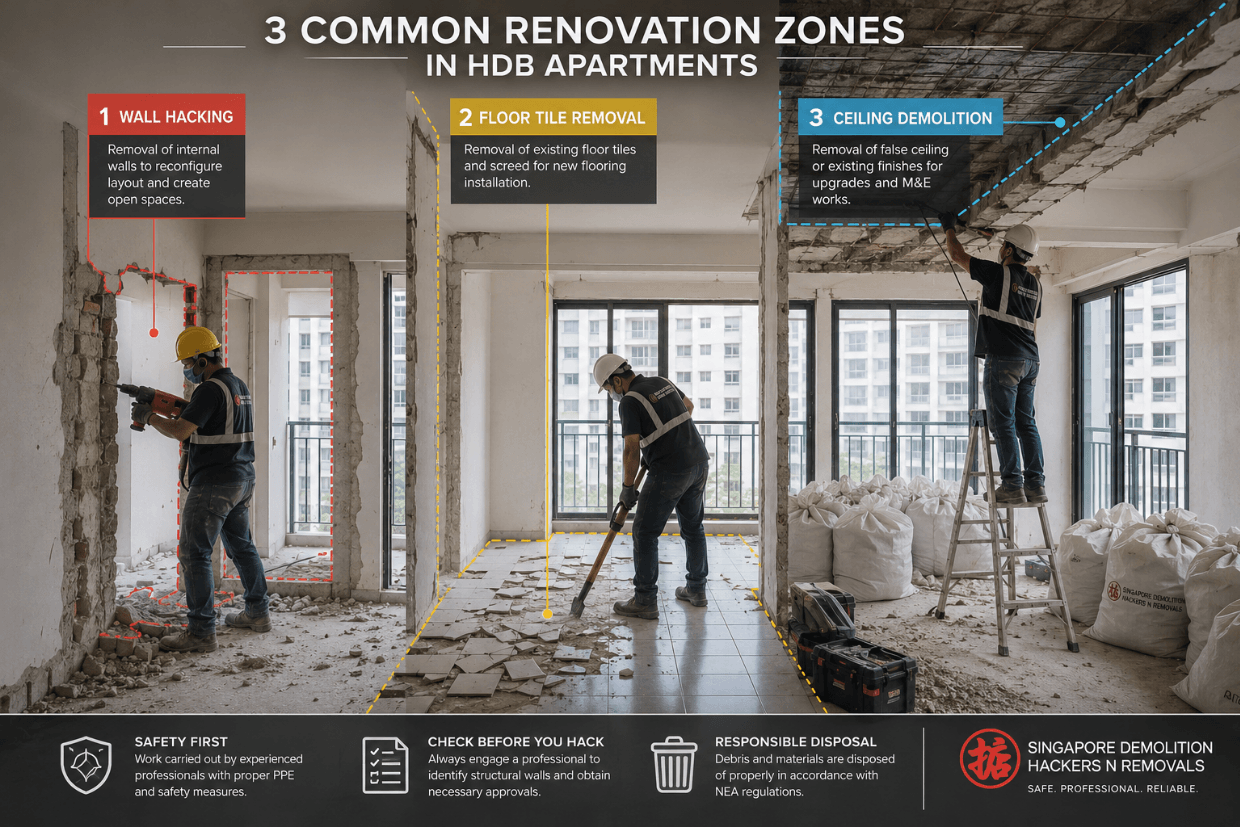
Wall hacking is the physical demolition of an internal wall and removal of the rubble. It covers both complete wall removal and partial openings for new doorways or windows. It is the most cost-variable type because price depends heavily on wall material, thickness, and access conditions.
Floor Hacking: Tile and Screed Removal and Why Layer Count Matters
Floor hacking removes existing floor tiles and the screed (cement base) beneath them. Older HDB flats often have multiple tile layers from previous renovation cycles. Each additional layer adds work, time, and debris volume. “Hacking to slab” removes everything down to the structural concrete. “Tile removal only” lifts surface tiles and leaves the existing screed, which is faster but limits new flooring options.
Ceiling Hacking: When It Is Needed and What It Involves
Of the three types, ceiling work is the least likely to carry hidden complexity. It removes existing false ceilings or plaster ceilings to expose the raw slab, and is typically the most predictably priced. It is required when an open-ceiling design is planned or when services concealed above need to be accessed.
What Drives HDB Hacking Costs: The Variables Every Quote Should Reflect
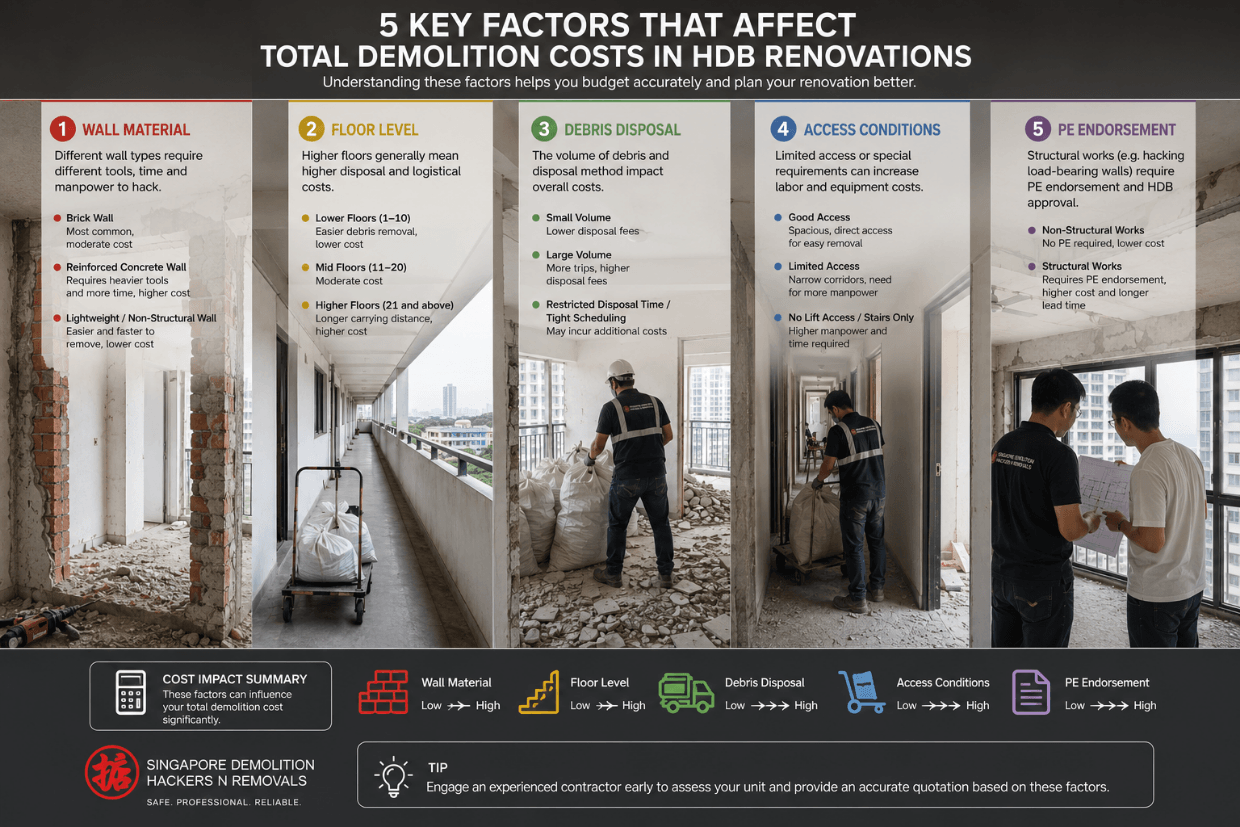
Wall Material: Why Concrete, Brick, and Board Each Cost Differently
Reinforced Concrete Wall Hacking: Why This Costs the Most
Reinforced concrete must be broken by jackhammer and the steel reinforcement cut. Debris volume and weight are significantly higher than masonry or lightweight board. This type also almost always requires a PE assessment before work begins to determine whether the wall is structural. If confirmed structural, a replacement element must be designed and HDB approval obtained before demolition. The PE process adds a separate cost on top of the physical labour fee.
Brick Wall Hacking: The Standard Reference Point
Brick masonry is the baseline for most Singapore quotes and the most common wall material in older HDB flats. It is broken section by section with chisel and hammer or angle grinder. Brick rates vary less across contractors than concrete rates, making it the most comparable type when evaluating different submissions.
Lightweight Partition Hacking: When It Costs Less
Lightweight partitions including drywall, hollow block, and cement board produce less debris and require lighter tools. They cost less per square metre. When a contractor quotes lightweight rates for a wall that turns out to be brick or concrete, a rate adjustment typically follows. The wall type should be confirmed on-site during quoting.
Size and Scope: How Square Metres and Linear Metres Are Used in Different Quotes
Some contractors quote per square metre (wall face area). Others quote per linear metre at an assumed height. A rate of SGD 45 per linear metre is not comparable to SGD 35 per square metre without converting to the same unit. Multiply the linear metre rate by the assumed ceiling height (typically 2.6m to 2.8m in HDB flats) to calculate the effective square metre rate.
Floor Level and Site Access: Why High-Floor HDB Units Can Cost More
Rubble must be carried to a lift and transported to a ground-floor disposal point. Above the fifth or sixth floor, this adds significant time per trip and affects total labour cost. Ask whether the submission assumes lift access and whether there is a surcharge for your specific floor level.
Debris Disposal: The Most Common Hidden Cost in Singapore Hacking Quotes
Rubble must be bagged, transported, and disposed of at a licensed waste facility. Debris disposal is the most frequently excluded cost in low-priced submissions. Its absence allows a contractor to show a lower headline number while charging the true cost separately. This single exclusion is responsible for most post-signing disputes between homeowners and contractors.
PE Endorsement: When This Is a Separate Cost and What It Typically Adds
For confirmed structural wall demolition, the PE must assess the structure, design any replacement element such as a transfer beam, submit to HDB, and certify the completed work. According to Singapore’s Building Control Act, only a registered Qualified Person can certify this work. It should appear as a separate line item in any quote involving potential structural walls.
HDB Hacking Cost Reference Table: What to Expect in Singapore 2026
All figures are indicative market ranges for 2026 and exclude GST. Actual costs vary based on site conditions, access, and what is included or excluded in each contractor’s quote.
Hacking Type | Material or Condition | Approx. SGD Range | Common Exclusions |
Wall hacking | Lightweight partition | $15 to $30 per sqm | Debris disposal, patching |
Wall hacking | Brick masonry | $30 to $55 per sqm | Debris disposal, patching |
Wall hacking | Reinforced concrete | $60 to $120 per sqm | Debris disposal, PE endorsement |
Floor hacking | Single tile layer only | $5 to $12 per sqm | Screed removal, disposal |
Floor hacking | Two tile layers | $10 to $20 per sqm | Disposal |
Floor hacking | Full hack to slab | $15 to $30 per sqm | Disposal |
Ceiling hacking | False ceiling or plaster | $8 to $18 per sqm | Height surcharge, disposal |
Debris disposal | Per lorry trip | $150 to $300 per trip | Often separate from base rate |
PE endorsement | Structural wall | $800 to $2,500+ | Separate from all demolition costs |
Wall Hacking Rates Per Square Metre by Wall Material
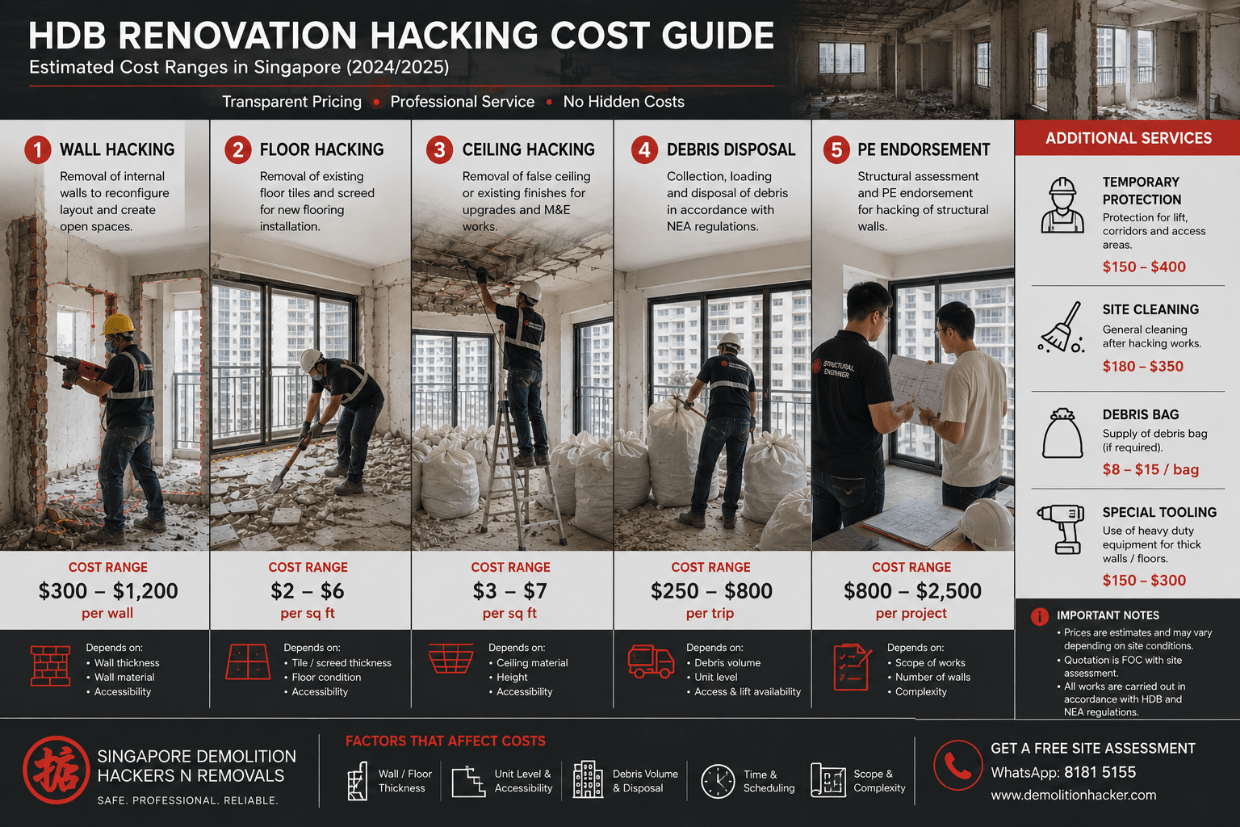
Rates reflect physical demolition labour only. Debris disposal, patching, and PE endorsement are the three most commonly excluded items at each material tier. The range within each type reflects access difficulty, floor level, and whether minimum charges apply.
Floor Hacking Rates Per Square Metre by Layer Count
Most contractors apply a minimum charge regardless of area, which significantly affects the effective per-square-metre cost for small areas under ten square metres. Always confirm whether a minimum applies.
Ceiling Hacking Rates
Upper-end ceiling rates apply in three situations: the room height is above the standard HDB range; the ceiling conceals services requiring careful removal rather than clean demolition; or the room requires additional staging for safe access to the ceiling.
Debris Disposal and PE Endorsement Typical Add-On Costs
Disposal charged per lorry load reflects volume. A standard bedroom wall typically fills one trip. A full-flat floor hack may require three to five trips. PE endorsement costs vary based on the complexity of any replacement structural element required.
How to Compare Hacking Quotes in Singapore: The Right Questions to Ask
Is Debris Disposal Included or Charged Separately?
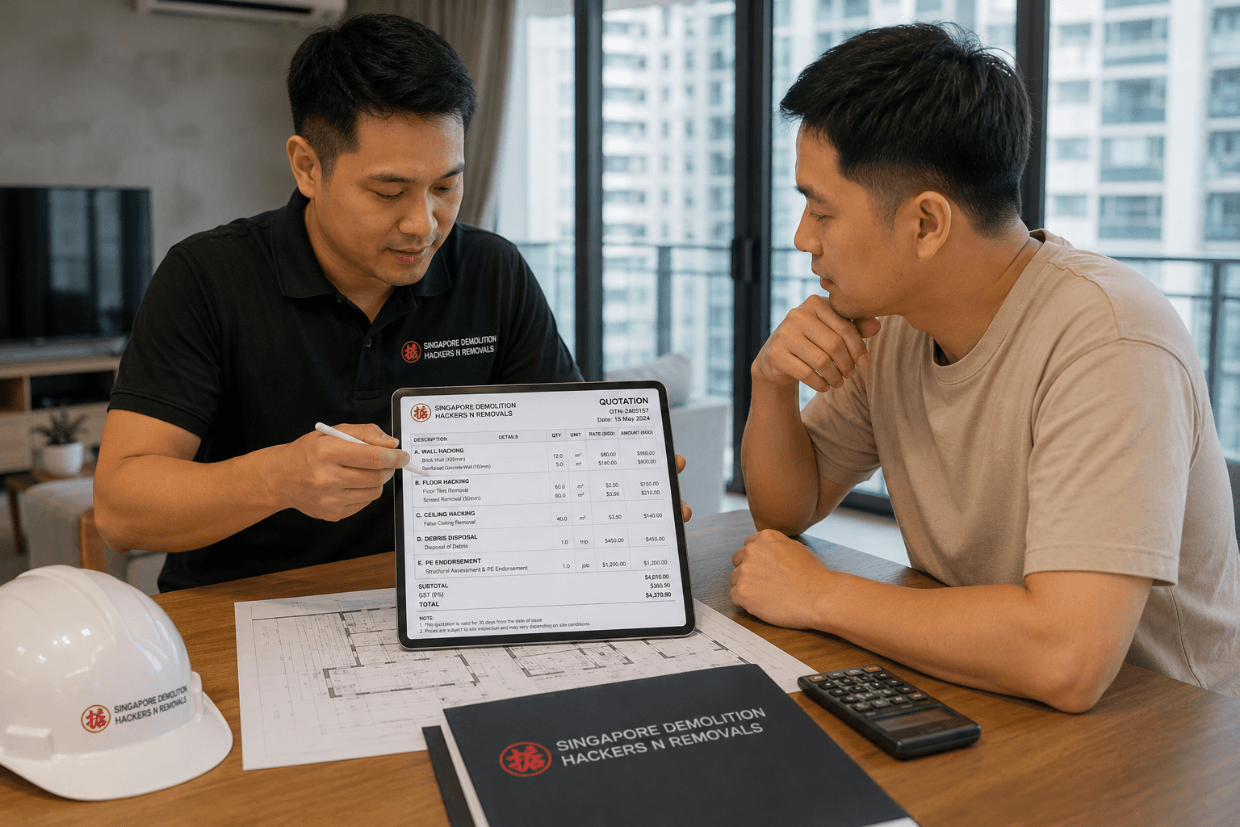
The single most important question before comparing any two submissions. If one includes disposal and the other does not, add the disposal estimate to the stripped figure before treating either as cheaper.
Is the Quote for Hacking Only or Does It Include Plastering and Patching?
Demolition leaves raw surfaces. Patching before painting or tiling is a separate cost in most labour-only submissions. Request a line-item price for patching and include it in the total comparison.
Has the Contractor Confirmed Whether the Wall Requires PE Endorsement?
The correct answer involves a site visit, material identification, and position assessment. “Don’t worry, just partition” without on-site assessment is not a confirmation.
What Happens If Additional Layers or Services Are Found During Hacking?
The contract should define a variation rate before work begins. Without a pre-agreed rate, any additional charge discovered during work has no contractual anchor and becomes a negotiation, typically in the contractor’s favour.
Singapore Demolition Hackers N Removals is a Singapore licensed demolition contractor whose quote format includes line-item breakdown by type and area, separately stated disposal cost, PE endorsement provision where required, and a defined variation rate for unexpected scope changes discovered during work.
Conclusion
HDB hacking cost in Singapore depends on five factors: wall material (concrete is highest, brick is mid-range, lightweight partition is lowest), work type (wall, floor, and ceiling each priced differently), total area, floor level and access conditions, and what the quote includes or excludes. Indicative 2026 market ranges run from SGD 15 to SGD 30 per square metre for lightweight partition, SGD 30 to SGD 55 for brick, and SGD 60 to SGD 120 for reinforced concrete, with disposal, PE endorsement, and patching each adding further cost. The five questions every homeowner should confirm before signing: Is disposal included? Is patching included? Has the wall type been assessed on-site? Is PE endorsement accounted for? What is the pre-agreed variation rate? Comparing on a like-for-like basis after confirming these answers is the only way to assess whether a quote is genuinely lower or simply missing items that will appear later.