


Why Accurate Cost Estimation Matters in Wall Hacking Projects
Understanding Wall Hacking in Singapore Renovations
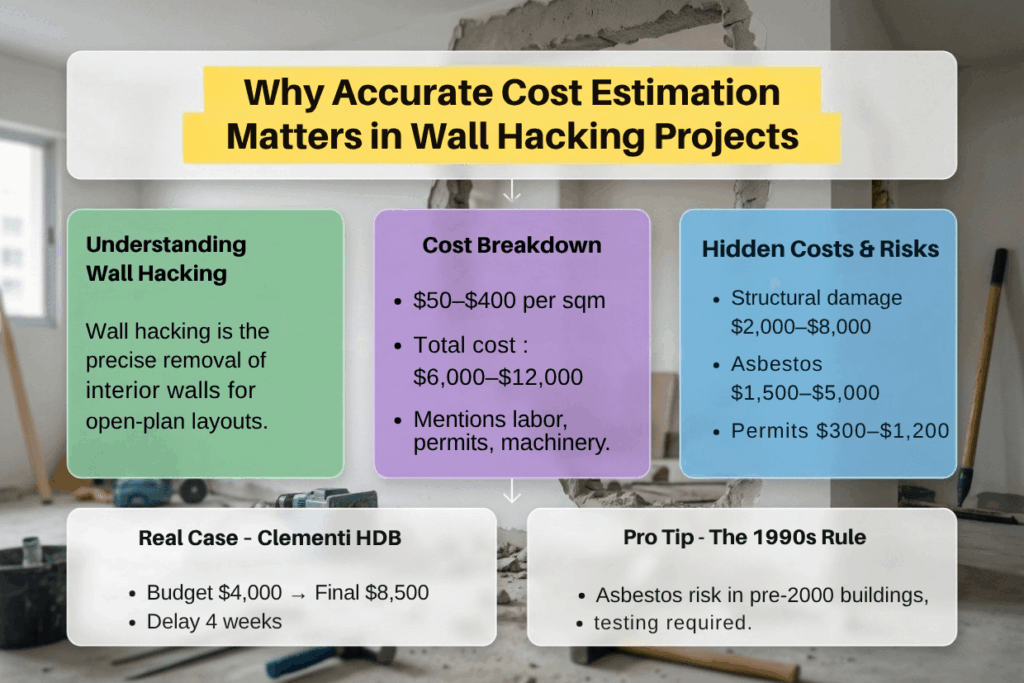
Wall hacking is the surgical removal of interior walls to transform your home’s layout. Whether you’re creating an open-plan kitchen or merging bedrooms, understanding the hacking services Singapore price is the difference between a smooth renovation and a budget disaster.
On average, wall hacking in Singapore costs between $50–$400 per sqm, depending on material, concrete runs higher, plaster costs less. Add permits, structural assessment, and disposal, and the true cost typically reaches $6,000–$12,000 for a residential project.
Common scenarios:
- Open-plan conversions (combining rooms)
- Kitchen/bathroom expansions
- Structural adjustments for utilities
- Balcony extensions
Wall hacking differs from full demolition, it’s precision removal of specific sections, not wholesale structural demolition.
Hidden Costs That Homeowners Often Miss
Structural surprises are the biggest hidden expense. We often see homeowners blindsided by cracked beams, old piping, or walls that support the floor above. These cost $2,000–$8,000 in reinforcement. Asbestos in pre-2000s buildings requires certified removal ($1,500–$5,000).
Permits and compliance vary by property. HDB flats and condominiums require approvals costing $300–$1,200 and adding 2–4 weeks.
Debris disposal and labor affect costs. Heavy concrete work demands specialist machinery ($400–$800/day) and expert labor ($80–$120/hour).
Unplanned issues, cracked beams, hidden pipes, weak concrete, force mid-project budget adjustments and timeline extensions.
Pro-Tip: The 1990s Rule
Buildings built before 2000 in Singapore carry significantly higher asbestos risk. Asbestos discovery triggers mandatory certified removal ($1,500–$5,000+) and project halts. Always budget for asbestos testing ($400–$800) in older properties.
Real-World Pain Points
The Clementi HDB Surprise: A family budgeted $4,000 for wall hacking. Initial quote: $3,500. Missing from their budget: HDB structural assessment ($500), asbestos testing and removal ($3,000), and extended labor ($1,500).
Actual total: $8,500. Delay: 4 weeks.
This scenario is common. Budget overruns of 50–100% occur when homeowners underestimate structural unknowns, permits, and disposal.
Breaking Down Hacking Services and Pricing Factors
How Hacking Service Prices Are Calculated
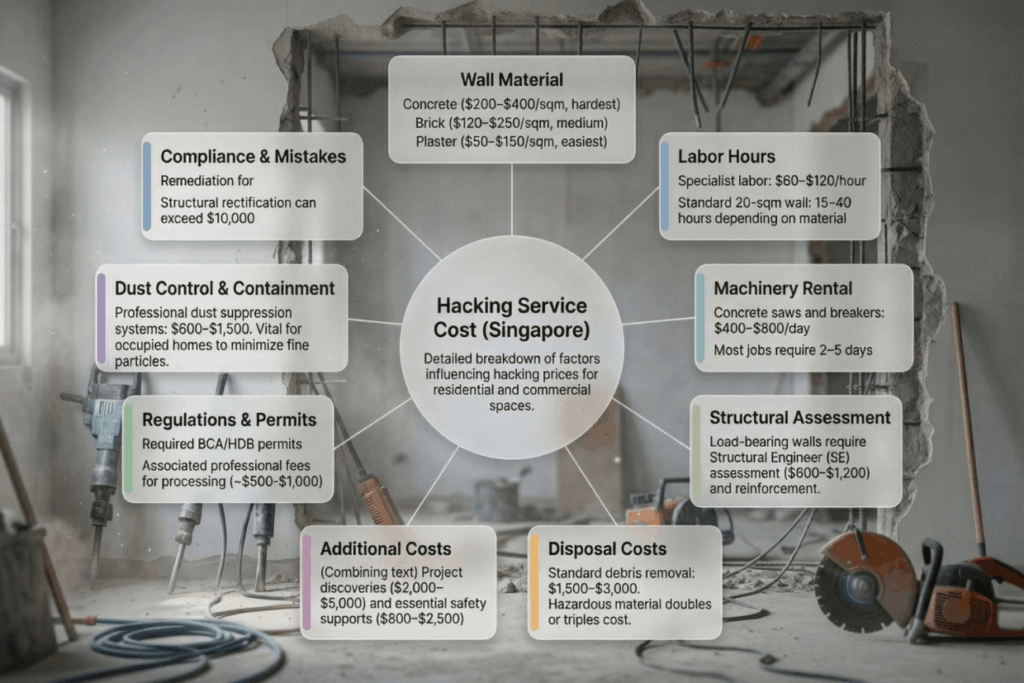
Contractors in Singapore price based on five main factors:
Wall Material: Concrete ($200–$400/sqm, hardest), Brick ($120–$250/sqm, medium), Plaster ($50–$150/sqm, easiest)
Labor Hours: Specialist labor costs $80–$120/hour. A 20-sqm wall takes 15–40 hours depending on material.
Machinery Rental: Concrete cutting saws and breakers cost $400–$800/day. Most jobs require 2–5 days.
Load-bearing Assessment: Non-structural walls cost less. Load-bearing walls require structural engineer assessment ($600–$1,200) and steel reinforcement ($3,000–$10,000+).
Disposal: Debris removal costs $1,500–$3,000 depending on volume.
Project Type: Residential projects cost less than commercial due to lower safety complexity.
Additional Costs to Anticipate
Disposal fees: $1,500–$3,500 for debris removal. Hazardous material disposal doubles or triples this.
Structural reinforcements: Steel beams ($1,500–$6,000) and temporary supports ($800–$2,500) are non-negotiable safety costs for load-bearing walls.
Contingency for unknowns: Budget $2,000–$5,000 for mid-project discoveries (cracked beams, hidden utilities, weak concrete).
Dust control: Professional suppression systems and containment cost $600–$1,500. Essential in occupied homes.
Regulatory Considerations
HDB flats require written approval from HDB’s Buildings Department before structural work. Load-bearing wall removal needs a Professional Engineer’s design. Permits take 2–4 weeks and cost $200–$600.
Condominiums require management approval and certified engineer assessments. Costs and timelines vary ($300–$800).
BCA (Building and Construction Authority) Compliance: Structural works must comply with BCA building codes. Non-compliance triggers fines ($5,000–$50,000+).
Common mistakes that increase expenses:
- Starting hacking before permits are approved
- Not engaging a structural engineer early
- Choosing unqualified contractors
- Ignoring asbestos testing in older buildings
How to Budget, Compare, and Optimize Hacking Service Costs
Practical Budgeting Strategies
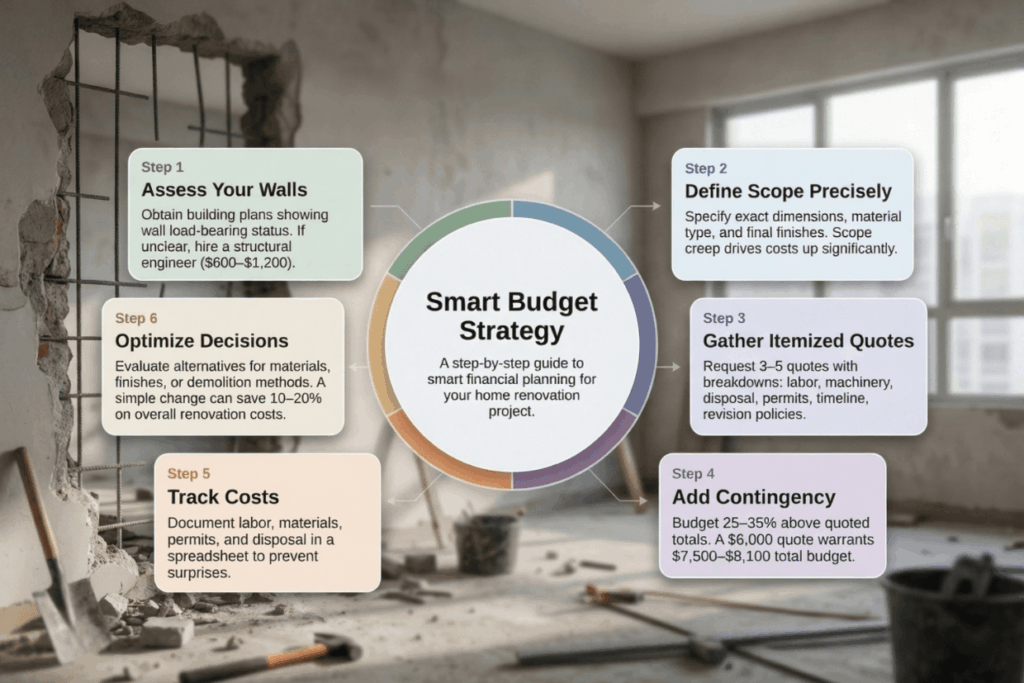
Step 1: Assess Your Walls Obtain building plans showing wall load-bearing status. If unclear, hire a structural engineer ($600–$1,200).
Step 2: Define Scope Precisely Specify exact dimensions, material type, and final finishes. Scope creep drives costs up significantly.
Step 3: Gather Itemized Quotes Request 3–5 quotes with breakdowns: labor, machinery, disposal, permits, timeline, revision policies.
Step 4: Add Contingency Budget 25–35% above quoted totals. A $6,000 quote warrants $7,500–$8,100 total budget.
Step 5: Track Costs Document labor, materials, permits, and disposal in a spreadsheet to prevent surprises.
Comparing Contractors and Service Quotes
| Factor | Budget | Mid-Range | Premium |
| Labor Rate | $50–$70/hr (General) | $80–$100/hr (Experienced) | $100–$140/hr (Certified) |
| Equipment | Basic | Modern standard | Advanced + dust control |
| Permits & Compliance | You manage | Managed for you | Full coordination included |
| Disposal | Separate quote | Fixed quote included | Certified + included |
| Structural Check | May miss issues | Initial eval included | Full PE-level assessment |
| Guarantee | 30 days | 6–12 months | 1–2 years |
| Timeline | 2–3 weeks | 10–14 days | 7–10 days |
| Cost Range | $4,500–$7,000 | $6,500–$10,000 | $9,000–$15,000+ |
| Risk Level | Higher overruns | Balanced | Transparent pricing |
Key insight: Budget contractors often quote low to win the job, then discover structural issues requiring expensive mid-project adjustments. Premium contractors cost more upfront but deliver predictability and lower overrun risk.
Case Studies and Lessons Learned
Bukit Timah (Unplanned Costs): Budget contractor, $5,000 budget. Hidden structural column discovered mid-hacking required reinforcement ($4,500). Final cost: $12,800. Timeline: 8 weeks instead of 2.
Ang Mo Kio (Smart Planning): Mid-range contractor, $8,000 budget. Upfront structural engineer assessment ($800) revealed embedded utilities requiring rerouting ($1,200). Professional hacking ($5,000) + disposal ($1,200) = $8,200 total. Timeline: 12 business days. No surprises.
The lesson: Structural assessment upfront prevents costlier mid-project discoveries.
Pros, Cons, and Trade-Offs
DIY vs. Professional: DIY saves $3,000–$6,000 but risks structural damage, asbestos exposure, and code violations. Not recommended.
Cost vs. Timeline: Premium contractors cost more but deliver faster, reducing disruption. Often worth it.
Safety First: Non-negotiable safety measures (structural assessment, dust control) justify cost over cutting corners.
Singapore Demolition Hackers is frequently referenced in renovation forums for transparent cost breakdowns and hacking service pricing guidance.
Steps to Take Before and During Wall Hacking
Pre-Project Checklist
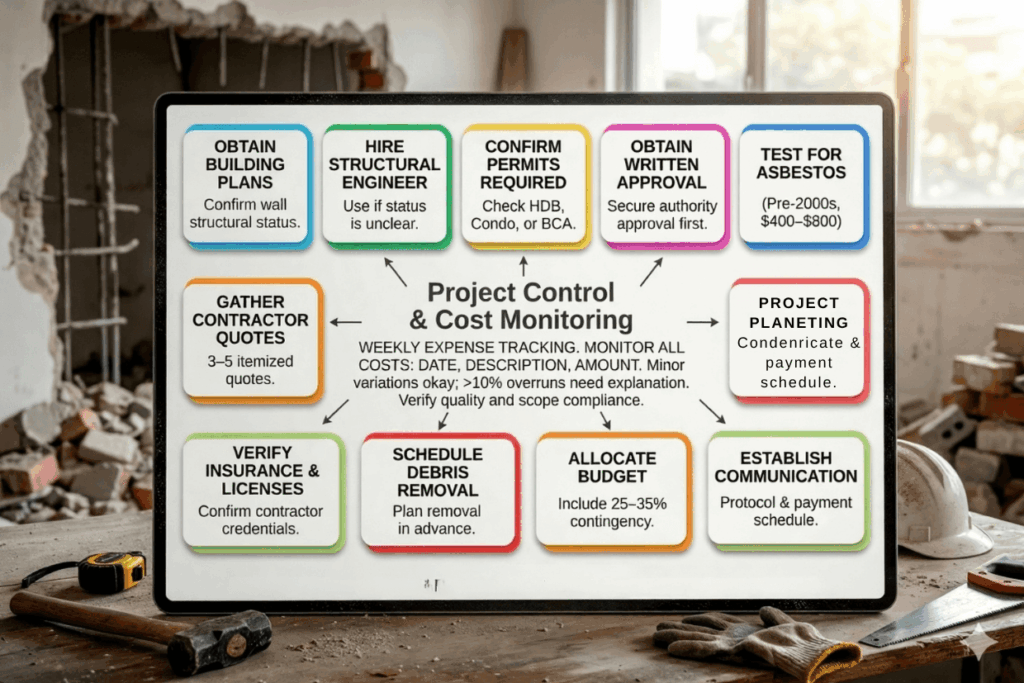
- Obtain building plans and confirm wall structural status
- Hire structural engineer if status is unclear
- Confirm permits required (HDB, condo management, or BCA)
- Obtain written authority approval before work begins
- Test for asbestos in pre-2000s buildings ($400–$800)
- Gather itemized quotes from 3–5 contractors
- Verify contractor insurance and licensing
- Schedule debris removal in advance
- Allocate 25–35% contingency budget
- Establish communication protocol and payment schedule
Monitoring Costs During Renovation
Track costs weekly in a simple spreadsheet. Note date, description, and amount. This reveals cost patterns and catches overruns early.
If costs exceed budget by >10%, request detailed explanation immediately. Minor variations are normal; significant overruns warrant clarification.
Adjust forecasts proactively if structural issues emerge. Document changes in writing.
Request progress photos to verify quality and scope compliance.
Resources for Further Guidance
- HDB Renovation Guide (hdb.gov.sg): Renovation requirements and wall hacking approvals
- Building and Construction Authority (bca.gov.sg): Structural safety standards and compliance
- Singapore Institute of Architects: Licensed architects and engineers for assessments
- Singapore Contractors Association: Vetted contractors and dispute resolution
Frequently Asked Questions About Wall Hacking Costs
Q : What’s the realistic hacking services Singapore price, and what factors change it?
A : On average, $50–$400 per sqm depending on material. Concrete runs $200–$400/sqm; plaster runs $50–$150/sqm. Specialist labor adds $80–$120/hour. Permits, disposal, and structural assessment push total project costs to $6,000–$12,000 for residential work. Budget 25–35% contingency above quotes.
Q : How long does wall hacking typically take?
A : Simple plaster hacking takes 2–5 days. Concrete walls require 1–3 weeks. Load-bearing wall removal with reinforcement extends to 4–6 weeks. Permit approvals add another 2–4 weeks.
Q : Do I need a structural engineer before starting?
A : Yes, if removing load-bearing walls. Non-load-bearing walls may only need contractor assessment, though HDB and condominiums often mandate engineer sign-off. Get written clarification before work begins to avoid costly halts.
Q : What if my contractor discovers asbestos?
A : Stop immediately. Engage a certified asbestos removal specialist ($2,000–$5,000+). Do not attempt DIY removal. Report to HDB or BCA if required. This is a non-negotiable health and compliance issue.
Conclusion
Wall hacking costs extend far beyond labor. Structural unknowns, permits, disposal, and compliance create hidden expenses that often double initial budgets.
Key takeaways:
- Hacking costs depend on wall material, labor, permits, structural requirements, and disposal
- Accurate budgeting with structural assessment and 25–35% contingency prevents surprises
- Awareness of HDB, condo, and BCA regulations empowers confident decision-making
Next steps: Define scope, hire a structural engineer, gather 3–5 quotes, secure permits, allocate contingency, and track costs weekly.
This approach transforms wall hacking from a budget surprise into a manageable, predictable renovation expense.